
Table of Contents
“People influence people. Nothing influences people more than a recommendation from a trusted friend.” — Mark Zuckerberg
Why Referral Programs Fail?
Referral programs are often hailed as one of the most effective and budget-friendly growth strategies for businesses of all sizes. The concept is simple: satisfied customers recommend your business to their friends, those friends become new customers, and the cycle repeats. However, despite this clear logic, many referral programs underperform or fail altogether.
So why do so many businesses invest time and resources into referral schemes only to see disappointing results? The answer lies not in the concept itself, but in the execution. From poorly designed incentives to inadequate promotion and clunky user experiences, there are numerous points where even well-intentioned programmes break down.
This article explores the core reasons why referral programmes fail, what the warning signs look like, and — most importantly — how to fix them. Whether you’re a Shopify store owner launching your first referral campaign, a marketing agency managing multiple client programmes, or a growing brand looking to scale customer acquisition, this guide will help you build a referral strategy that actually delivers results.
What Is a Referral Programme and How Does It Work

Referral marketing is one of the oldest forms of customer acquisition, yet it remains one of the most misunderstood. At its core, a referral programme is a structured system that encourages existing customers or advocates to recommend a product or service to others — typically in exchange for a reward. Unlike organic word-of-mouth, a referral programme is intentional, measurable, and designed to scale.
The Core Mechanics Behind a Referral Programme
The mechanics are straightforward. A business provides a unique referral link or code to an existing customer (the referrer). When that customer shares the link and a new person (the referee) completes a desired action — such as making a purchase or signing up — both parties typically receive a reward. This creates a mutually beneficial loop that incentivises sharing while expanding the customer base.
Modern referral programmes rely on referral tracking software to monitor link clicks, sign-ups, and conversions in real time. Platforms such as ReferralCandy, Friendbuy, and Yotpo automate much of this process, making it easier for businesses to manage programme logistics without manual oversight.
Referral marketing strategy focuses on encouraging and incentivizing existing customers to recommend a company’s products or services to their friends, family, and colleagues. By leveraging the trust and personal connections between referrers and potential new customers, businesses can increase their customer base more effectively and at a lower cost compared to traditional advertising methods. Successful referral programs often include rewards, discounts, or exclusive offers to motivate participants, creating a win-win situation for both the company and its customers. Read full article here
Types of Referral Programmes Businesses Use
Not all referral programmes are built the same. The structure you choose should align with your business model, customer behaviour, and growth objectives.
| Programme Type | How It Works | Best Suited For |
|---|---|---|
| Customer Referral Programme | Existing customers refer friends in exchange for discounts or credits | E-commerce, SaaS, subscription services |
| Affiliate Programme | Partners earn a commission for each sale they generate | Content creators, bloggers, influencers |
| Employee Referral Programme | Staff refer job candidates and receive bonuses | Recruitment, HR departments |
| Partner/B2B Referral Programme | Business partners refer clients for revenue share | Agencies, consultancies, B2B software |
| Influencer Referral Programme | Influencers share unique codes with their audience | Consumer brands, lifestyle products |
Choosing the right type is the first critical decision — and getting it wrong is one of the earliest reasons referral strategies begin to falter.
Why Referral Programmes Matter for Business Growth
“Word of mouth is the primary factor behind 20 to 50 percent of all purchasing decisions.” — McKinsey & Company
The business case for referral marketing is compelling. Referred customers are not only cheaper to acquire — they also tend to be more loyal, spend more over time, and are more likely to refer others themselves. This compounding effect makes a well-executed referral programme one of the highest-return investments a business can make.
The Real Value of Word-of-Mouth Marketing
Trust is the currency of modern commerce. Consumers are increasingly sceptical of traditional advertising, yet they remain highly receptive to recommendations from people they know. Research consistently shows that referred customers have a higher lifetime value — often 16% or more — compared to customers acquired through paid channels.
For small businesses and Shopify store owners in particular, this matters enormously. Competing on paid advertising budgets with larger brands is rarely sustainable. A strong referral programme levels the playing field by turning your existing customer base into a distributed sales force — one that operates on genuine trust rather than manufactured persuasion.
How Referral Programmes Compare to Other Acquisition Channels
When evaluated against other marketing channels, referral programmes consistently demonstrate strong performance across key metrics:
- Cost per acquisition is typically lower, as rewards are only paid upon successful conversion
- Conversion rates from referred leads are significantly higher than from cold paid traffic
- Referred customers exhibit stronger brand loyalty and lower churn rates
- The programme becomes more powerful over time as the customer base grows
Unlike pay-per-click advertising, which stops delivering the moment you pause spend, a referral programme builds compounding momentum — each new customer becomes a potential advocate, creating a self-reinforcing growth engine that scales with your business.
Why Referral Programs Fail: The Most Common Reasons
Despite the proven potential of referral marketing, the uncomfortable truth is that programme failure is far more common than success. Most businesses launch a referral scheme with genuine enthusiasm, only to watch participation rates stagnate and conversions flatline. Understanding why referral programs fail is the essential first step toward building one that actually works.
The problems rarely stem from a single cause. More often, it is a combination of structural weaknesses — flawed incentives, poor visibility, and friction-filled user experiences — that collectively undermine even the most well-intentioned efforts.
Poor Incentive Design That Fails to Motivate
The incentive is the engine of any referral programme. Get it wrong, and nothing else matters. One of the most frequent mistakes businesses make is offering rewards that simply do not resonate with their audience. A 10% discount might feel generous to the business owner, but if it fails to create genuine excitement for the customer, it will not move the needle.
Incentive design failures typically fall into several categories: rewards that are too small to justify the social effort of referring, rewards that are misaligned with customer preferences (offering store credit to customers who rarely repurchase, for example), and overly complex redemption processes that make claiming rewards more trouble than they are worth. When the perceived effort outweighs the perceived reward, customers simply will not participate.
Lack of Visibility and Promotion
Even a brilliantly designed referral programme will fail if customers do not know it exists. Programme invisibility is one of the most underestimated reasons for poor performance. Many businesses launch their referral scheme with a single email announcement and then assume word will spread organically.
The most common visibility failures include:
- Burying the referral programme in a website footer where few customers ever look.
- Sending only one promotional email at launch with no follow-up communications.
- Failing to mention the programme at high-intent touchpoints such as post-purchase confirmation pages.
- Not training customer service staff to actively promote the programme during interactions.
- Neglecting to feature the programme on social media channels where the audience is already engaged.
- Overlooking in-app or on-site prompts that could surface the programme at the right moment.
Visibility is not a one-time task — it requires consistent, multi-channel reinforcement to keep the programme front of mind.
Key Components of a High-Performing Referral Programme
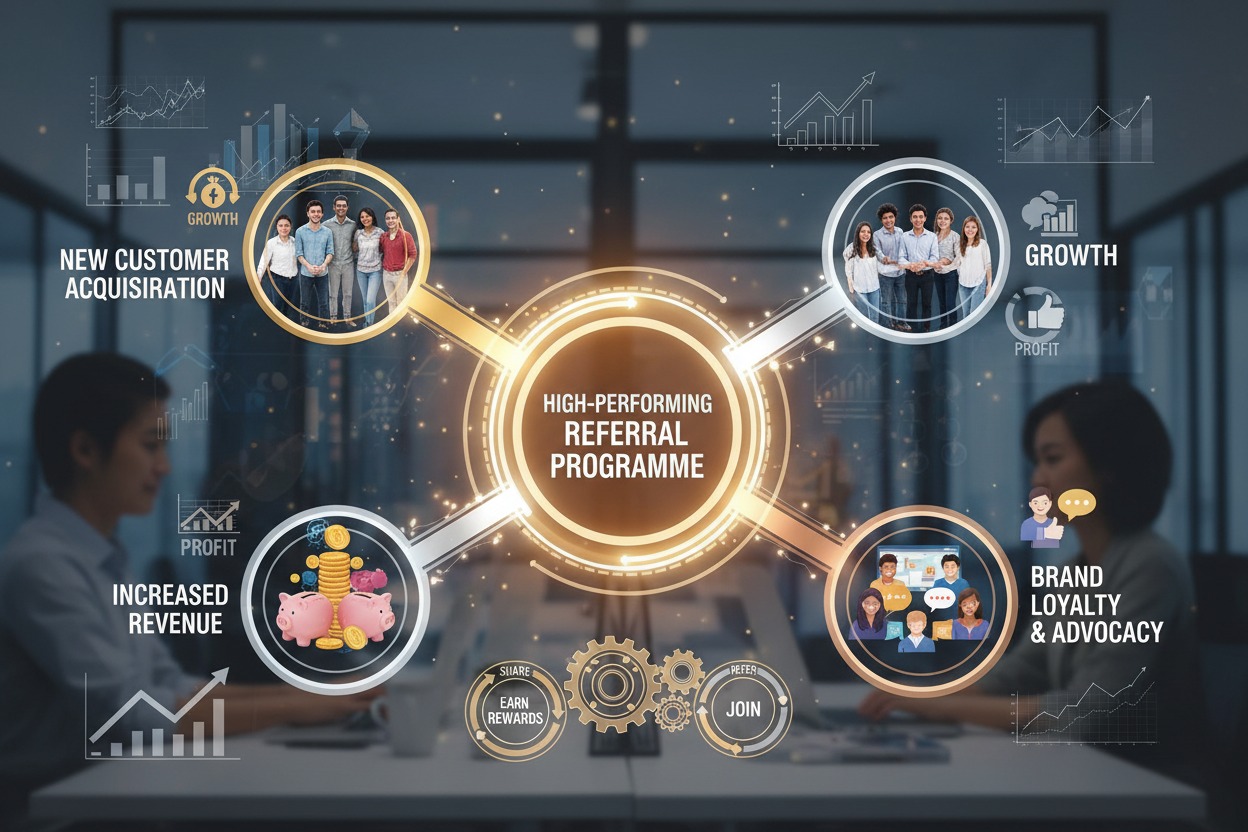
What separates a referral programme that drives meaningful growth from one that quietly collects dust? The answer lies in a handful of core components that, when executed correctly, work together to create a seamless and compelling experience for both referrers and new customers.
| Component | What It Involves | Why It Matters |
|---|---|---|
| Clear Value Proposition | Communicating the reward and process in plain language | Reduces confusion and increases participation rates |
| Compelling Incentive Structure | Offering relevant, desirable rewards for both parties | Motivates action and sustains long-term engagement |
| Simple Sharing Mechanism | One-click sharing via email, WhatsApp, social media | Removes friction and makes referral effortless |
| Reliable Tracking System | Unique links, cookies, or codes to attribute referrals accurately | Builds trust and ensures rewards are delivered correctly |
| Timely Reward Delivery | Automatic or fast fulfilment of promised rewards | Reinforces positive behaviour and encourages repeat referrals |
| Ongoing Promotion | Regular reminders across email, SMS, and on-site placements | Keeps the programme visible and top of mind |
Reward Structures That Actually Drive Action
The most effective reward structures are those that feel genuinely valuable to the customer, not just affordable to the business. Dual-sided rewards — where both the referrer and the referee receive something — consistently outperform one-sided models because they give the referrer a socially acceptable reason to share. Nobody wants to feel like they are selling to their friends; a gift for both parties reframes the act as generosity rather than promotion.
Dropbox’s legendary referral programme, which offered additional free storage space to both parties, is a textbook example of a reward that was perfectly aligned with what users actually wanted. The lesson: the best rewards are those that are directly tied to the core value your product delivers.
Seamless Sharing and Tracking Mechanisms
A referral programme is only as strong as its user experience. If sharing a referral link requires multiple steps, account logins, or confusing instructions, most customers will abandon the process before completing it. The goal is to make sharing feel effortless — ideally a single tap or click that surfaces pre-populated messages ready to send via WhatsApp, email, or social media.
On the back end, accurate attribution is equally critical. Customers must trust that their referrals will be tracked and rewarded correctly. Broken tracking links, delayed confirmations, or unexplained reward failures destroy confidence in the programme and discourage future participation.
UpViral is a powerful automated marketing tool designed to boost your online presence through viral contests and referral campaigns. It enables users to effortlessly create shareable campaigns that encourage participants to spread the word, thereby increasing engagement and expanding reach. With comprehensive tracking features, UpViral provides real-time analytics to monitor campaign performance and participant activity, ensuring you can optimize your strategies effectively. To learn more about how UpViral can transform your marketing efforts, read the full UpViral review here.
How to Fix a Failing Referral Programme
Diagnosing and reviving a struggling referral programme is entirely achievable, provided you approach the process systematically rather than making reactive, piecemeal changes. The most successful fixes begin with honest assessment and follow a structured path toward improvement.
“The definition of insanity is doing the same thing over and over and expecting different results.” — often attributed to Albert Einstein
This principle applies directly to referral programme management. If your current programme is underperforming, repeating the same approach will not produce a different outcome.
Auditing Your Current Programme for Weak Points
Before making any changes, conduct a thorough audit across every stage of the referral journey. Work through the following steps:
- Review your participation rate — what percentage of eligible customers have actually made a referral?
- Analyse the drop-off points — are customers clicking the share button but not completing the referral?
- Assess reward relevance by surveying customers about what incentives would genuinely motivate them.
- Test every step of the sharing and redemption process yourself to identify friction points.
- Evaluate your promotion strategy — how many touchpoints are actively surfacing the programme?
- Check your tracking accuracy by running test referrals to confirm attribution is working correctly.
Testing, Iterating, and Optimising Over Time
Fixing a referral programme is not a one-time event — it is an ongoing process of structured experimentation. Once your audit identifies weak points, prioritise changes based on potential impact and test them systematically. Adjust one variable at a time so you can clearly attribute improvements to specific changes.
A/B testing different reward types, sharing copy, and promotional placements will reveal what resonates most with your specific audience. Platforms such as ReferralCandy and Friendbuy offer built-in analytics that make this process considerably more straightforward. Track metrics including referral conversion rate, cost per referred acquisition, and referred customer lifetime value to build a clear picture of programme health over time.
The businesses that build high-performing referral programmes are rarely those that got everything right on the first attempt — they are the ones that committed to continuous improvement, treated data as a guide rather than a verdict, and remained willing to adapt.
Common Misconceptions About Referral Programmes
Even among experienced marketers, several persistent myths continue to shape — and sabotage — referral programme strategy. Addressing these misconceptions directly is essential for anyone serious about building a programme that performs.
The most damaging misconception is that a referral programme will grow organically once it is launched. Many business owners assume that satisfied customers will naturally begin sharing without any prompting or ongoing promotion. In reality, even your most loyal advocates need a clear invitation, a compelling reason, and a frictionless mechanism to refer others. Passive programmes produce passive results.
A second widely held belief is that discounts and cash rewards are universally the most effective incentives. While financial rewards work well in many contexts, they are not always the right fit. For premium brands, offering a discount can actually undermine perceived value. For subscription businesses, exclusive access or tier upgrades may drive far stronger engagement than monetary incentives ever could. The most effective reward is the one your specific audience finds genuinely desirable — and that requires research, not assumption.
Another common myth is that referral programmes are only suitable for large businesses with established customer bases. In truth, small businesses and early-stage Shopify stores can benefit enormously from referral marketing, often more so than larger competitors, because personal trust carries greater weight in smaller communities. A boutique fitness studio or an independent skincare brand can generate remarkable growth through a well-structured referral scheme precisely because their customer relationships are more personal and authentic.
Finally, many businesses believe that technology alone will solve their referral challenges. Installing a referral platform is a starting point, not a solution. The platform is simply the infrastructure — the programme still requires thoughtful incentive design, consistent promotion, and ongoing optimisation to deliver meaningful results. Automation supports a good strategy; it cannot replace one.
Conclusion
Understanding why referral programmes fail is not an academic exercise — it is a practical necessity for any business that wants to grow sustainably. The evidence is clear: referral marketing works, but only when it is built on sound foundations. Poor incentive design, inadequate visibility, clunky user experiences, and a failure to iterate are the silent killers of otherwise promising programmes.
The good news is that every one of these failure points is fixable. With an honest audit, a willingness to test and adapt, and a genuine focus on what your customers actually value, a struggling referral programme can be transformed into one of your most reliable growth channels.
Whether you are launching your first programme or reviving a stalled one, the principles remain the same: make it simple, make it rewarding, make it visible, and never stop improving. The businesses that get this right do not just acquire more customers — they build communities of advocates that drive compounding, long-term growth.
Frequently Asked Questions
How long does it take for a referral programme to show results?
Most referral programmes begin generating measurable activity within four to eight weeks of launch, provided they are actively promoted. However, meaningful results — sufficient referral volume to impact overall acquisition metrics — typically take three to six months to materialise. The timeline depends heavily on the size of your existing customer base, the quality of your incentive, and the consistency of your promotional efforts. Programmes that are promoted across multiple channels from day one tend to gain traction considerably faster.
What is the ideal reward for a referral programme?
There is no single ideal reward — the most effective incentive is one that is directly aligned with what your customers value most. For e-commerce brands, store credit or free products tend to perform well. For SaaS businesses, extended trials or feature upgrades are often more compelling than cash. The key principle is to offer dual-sided rewards — something for both the referrer and the new customer — as this consistently outperforms one-sided models by giving customers a socially comfortable reason to share.
How do I know if my referral programme is underperforming?
The clearest indicators are a low participation rate (fewer than 5% of eligible customers making a referral), a high share-to-conversion drop-off, and stagnant or declining referral volumes over time. If customers are clicking the share button but referred leads are not converting, the issue likely lies with the landing experience or reward relevance. Regularly reviewing these core metrics through your referral platform’s analytics dashboard will help you identify problems before they become entrenched.
Can referral programmes work for service-based businesses?
Absolutely. Service-based businesses — including marketing agencies, consultancies, personal trainers, and accountants — are often exceptionally well-suited to referral marketing because trust plays such a central role in the buying decision. A personal recommendation carries enormous weight when someone is choosing a service provider. Offering a meaningful incentive, such as a complimentary session, a discount on the next invoice, or a charitable donation in the referrer’s name, can make the programme feel natural and generous rather than transactional.
Leave a Reply