
Table of Contents
In today’s digital landscape, traditional marketing approaches are increasingly losing their grip on consumer attention. Attention spans are shorter, advertising budgets stretch thinner, and competition for visibility intensifies daily. Yet some brands manage to achieve extraordinary reach with minimal spending—their campaigns spread organically across social platforms, generating millions of impressions without proportional advertising investment. This phenomenon isn’t luck; it’s the result of strategic viral marketing.
Viral marketing strategy represents one of the most powerful yet misunderstood tools in modern business. For small business owners, Shopify store proprietors, influencers, and growth-focused brands, understanding how to engineer viral moments can transform market presence and revenue potential. A single well-crafted campaign can elevate an unknown brand into household recognition, whilst poorly executed attempts waste resources and damage credibility.
This comprehensive guide explores the mechanics of viral marketing strategy, separating genuine tactics from misconceptions. You’ll discover how successful campaigns leverage psychology, shareability, and network effects to achieve exponential growth. Whether you’re launching a new product, building brand awareness, or seeking cost-effective marketing solutions, mastering viral marketing strategy provides a competitive advantage that traditional channels simply cannot match.
What Is Viral Marketing Strategy?
Viral marketing strategy is a deliberate approach designed to encourage rapid, organic sharing of marketing content across networks. Unlike traditional advertising that pushes messages outward, viral marketing creates content so compelling, entertaining, or valuable that audiences voluntarily distribute it themselves. This exponential distribution occurs through social networks, messaging platforms, and word-of-mouth channels, multiplying reach far beyond initial investment.
The term “viral” draws from epidemiology—just as viruses spread through populations via person-to-person contact, viral marketing spreads through digital networks via user-to-user sharing. However, successful viral campaigns aren’t accidental. They’re engineered through careful consideration of audience psychology, content format, timing, and distribution mechanics.
“Viral marketing isn’t about luck—it’s about creating content so valuable or entertaining that people feel compelled to share it with their networks because it reflects positively on them.”
A true viral marketing strategy encompasses several dimensions. First, the content itself must possess inherent shareability—it should be memorable, emotionally resonant, or provide genuine value. Second, the campaign requires strategic seeding, ensuring initial visibility among influential users or communities. Third, the mechanics must facilitate frictionless sharing across multiple platforms. Finally, the timing and cultural relevance determine whether content resonates or falls flat.
Best Giveaway Software offers an easy and efficient way to run contests and giveaways online. It provides customizable features, automated entry collection, and social media integration to help increase engagement and grow your audience. With user-friendly interfaces and reliable support, this software is ideal for businesses and influencers looking to boost their marketing efforts. You can read more about the top options and their benefits here.
Real-world examples illustrate this distinction. Blendtec’s “Will It Blend?” campaign succeeded because it combined entertainment value with product demonstration, making each video inherently shareable. Similarly, Dollar Shave Club’s irreverent founder video went viral not through paid promotion but because the authentic, humorous approach resonated so strongly that viewers organically shared it. These weren’t random successes—they resulted from strategic decisions about content, tone, and distribution.
Why Viral Marketing Matters for Your Business
Viral marketing strategy offers transformative benefits for businesses operating in competitive markets. The primary advantage lies in achieving exponential reach without proportional advertising expenditure. When content spreads organically, each share extends your message to new audiences at minimal cost, creating a multiplier effect that traditional paid advertising struggles to achieve. This efficiency proves particularly valuable for resource-constrained businesses including startups, small enterprises, and emerging brands.
The Impact on Brand Awareness
Viral marketing strategy generate unprecedented visibility within compressed timeframes. A single viral piece can generate millions of impressions, creating brand awareness that would require substantial paid advertising budgets to replicate. This visibility translates into tangible business outcomes: increased website traffic, higher search engine rankings, and improved brand recall among target audiences.
Beyond raw numbers, viral campaigns create psychological ownership among audiences. When people voluntarily share content, they become brand ambassadors, lending their personal credibility to your message. This peer-to-peer endorsement carries significantly more weight than traditional advertising, as recommendations from trusted networks influence purchasing decisions far more powerfully than branded messaging.
Additionally, viral success establishes market authority and relevance. Brands that successfully create viral moments are perceived as culturally attuned, innovative, and worthy of attention. This perception opens doors for future campaigns, media coverage, and partnership opportunities that wouldn’t otherwise materialise.
Cost-Effectiveness Compared to Traditional Marketing
The financial advantage of viral marketing cannot be overstated. Traditional advertising—whether television, print, or paid digital—requires continuous spending to maintain visibility. Viral campaigns, conversely, generate sustained reach through a single content investment. A £5,000 investment in a viral video might generate equivalent reach to a £50,000 paid advertising campaign, depending on shareability and audience response.
This cost efficiency extends beyond immediate reach. Viral content generates secondary benefits including earned media coverage, influencer mentions, and organic social media engagement that amplify the original investment. News outlets, bloggers, and journalists frequently cover viral phenomena, providing additional exposure without additional spending.
Furthermore, viral campaigns generate valuable data and insights about audience preferences, content formats, and messaging that resonate. This intelligence informs future marketing efforts, improving overall campaign effectiveness across all channels. For growth-focused brands and marketing agencies, this intelligence proves invaluable for scaling successful strategies and optimising resource allocation.
Key Components of a Successful Viral Marketing Strategy

Successful viral campaigns share identifiable structural elements that distinguish them from failed attempts. Understanding these components allows marketers to systematically build campaigns with viral potential rather than relying on chance. The most effective viral marketing strategies combine emotional triggers, content design, distribution mechanics, and audience psychology into cohesive systems.
| Component | Function | Example |
|---|---|---|
| Emotional Hook | Creates immediate engagement and desire to share | Humour, nostalgia, inspiration, surprise |
| Simplicity | Ensures easy comprehension and rapid sharing | Single core message, clear narrative arc |
| Platform Optimisation | Tailors content format to each distribution channel | Short-form video for TikTok, carousel posts for Instagram |
| Timing and Relevance | Aligns content with cultural moments or trends | Seasonal campaigns, trending topics, current events |
| Shareability Mechanics | Removes friction from the sharing process | Direct share buttons, hashtag campaigns, user-generated content prompts |
| Seed Distribution | Ensures initial visibility among key audiences | Influencer seeding, community targeting, paid amplification |
The foundational elements of viral campaigns extend beyond content creation. Successful campaigns require strategic distribution planning, ensuring content reaches early adopters and influential nodes within networks. These initial shares generate momentum, creating visibility that attracts broader audiences. Without deliberate seeding, even exceptional content may languish unnoticed.
Emotional Resonance and Relatability
Emotional connection represents the primary driver of viral sharing. People share content that makes them feel something—whether joy, outrage, inspiration, or amusement. Content triggering strong emotional responses generates higher share rates because individuals want to propagate those feelings through their networks.
Relatability amplifies emotional resonance. Campaigns that reflect audience experiences, challenges, or aspirations resonate more powerfully than generic messaging. When viewers see themselves represented in content, they’re more likely to share it with their networks. This principle explains why user-generated content campaigns consistently outperform branded content—audiences recognise authentic peer experiences rather than corporate messaging.
Shareability and Network Effects
Network effects describe how content value increases with each additional share. As more people encounter content through trusted sources, they’re more likely to engage and share further, creating exponential growth curves. This multiplication effect distinguishes viral campaigns from standard marketing, where reach plateaus after initial investment.
Shareability mechanics must be frictionless. Content requiring multiple steps to share experiences significantly reduced distribution. Conversely, campaigns with integrated share buttons, pre-written hashtags, or simple participation mechanisms dramatically increase sharing rates. Instagram’s Stories feature and TikTok’s duet functionality exemplify how platform mechanics can facilitate viral spread by removing sharing friction.
How Viral Marketing Campaigns Work
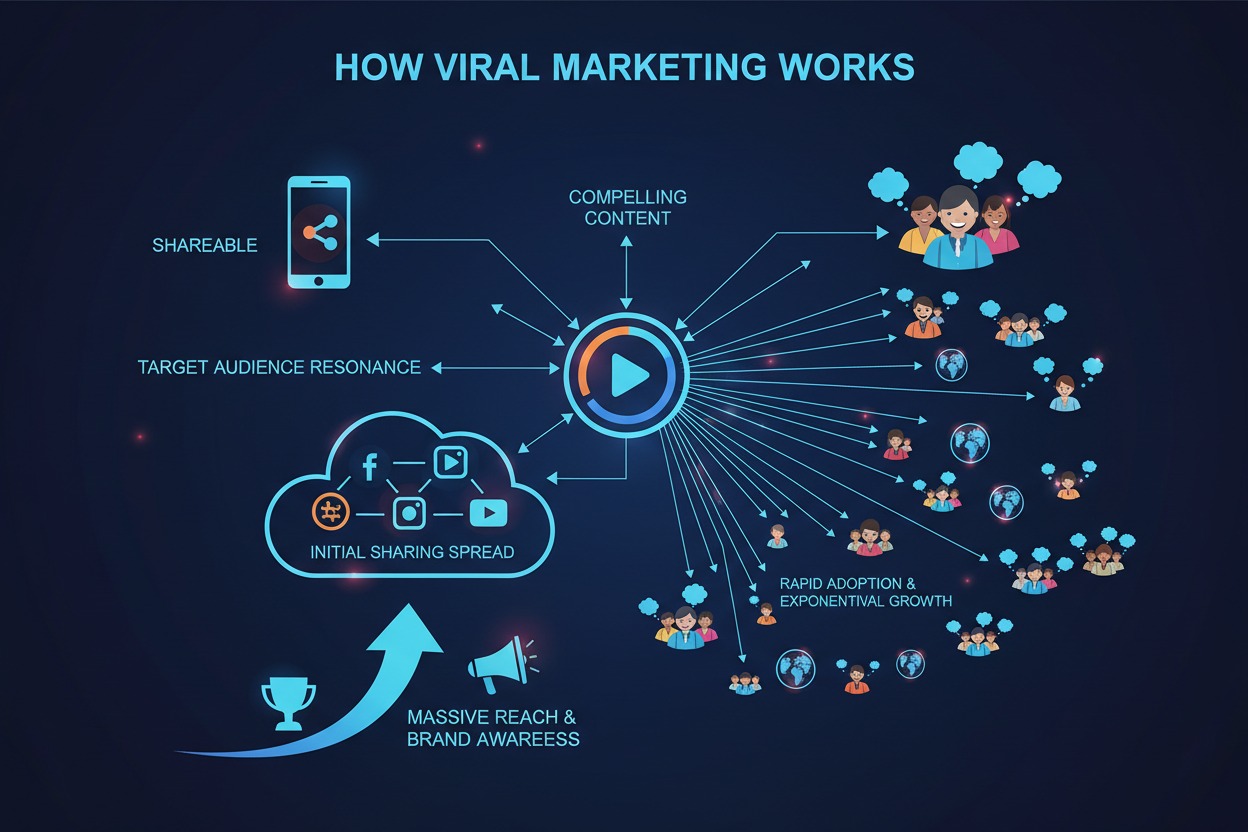
Viral campaigns operate through predictable psychological and mechanical processes. Understanding these mechanisms reveals why certain content spreads whilst other messages stall. The process begins with content creation designed around shareability principles, followed by strategic seeding to generate initial visibility, then exponential amplification as network effects multiply reach.
“The difference between content that goes viral and content that doesn’t often comes down to whether the audience feels compelled to share it because it makes them look good to their social networks.”
The mechanics of viral spread follow recognisable patterns. Initial shares occur within tight communities—early adopters, loyal followers, or niche audiences aligned with content themes. As these shares accumulate, content gains algorithmic visibility on social platforms, extending reach to adjacent networks. This secondary wave introduces content to broader audiences, some of whom share further, creating cascading distribution waves.
Momentum building requires critical mass at early stages. Campaigns failing to achieve sufficient initial shares rarely recover, as algorithmic visibility diminishes without engagement signals. Conversely, campaigns achieving early traction benefit from algorithmic amplification, creating self-reinforcing cycles where visibility generates engagement, which generates further visibility.
The Psychology Behind Viral Content
Human psychology fundamentally drives viral sharing decisions. People don’t share randomly; they share strategically to craft desired social impressions. Content offering identity affirmation—demonstrating values, humour, or sophistication the sharer wants associated with their personal brand—receives priority sharing.
Social currency explains much viral behaviour. Sharing exclusive, surprising, or entertaining content elevates the sharer’s status within their networks. This motivation explains why witty commentary, exclusive previews, or shocking revelations spread rapidly. Individuals compete to share content first, establishing themselves as information sources within their circles.
Additionally, narrative consistency influences sharing. People share content reinforcing their existing worldviews and values. Campaigns aligning with audience beliefs and identities experience higher share rates than contradictory messages. This principle explains why polarising content often goes viral—it strongly aligns with specific audience segments, driving intense sharing within those communities.
The Role of Influencers and Amplification
Influencers function as network bridges, connecting content creators to broader audiences. Strategic influencer partnerships dramatically accelerate viral spread by providing initial visibility to established follower bases. However, influencer effectiveness depends on authenticity alignment—audiences detect inauthentic endorsements, reducing campaign impact.
Micro-influencers frequently outperform macro-influencers for viral campaigns. Whilst macro-influencers command larger audiences, micro-influencers demonstrate higher engagement rates and greater audience trust. Their followers perceive recommendations as authentic rather than transactional, generating more genuine sharing behaviour.
Amplification extends beyond individual influencers. Community seeding—strategically sharing content within relevant online communities, forums, and niche networks—generates organic momentum. Reddit communities, Facebook groups, and Discord servers often serve as viral incubators, where engaged audiences amplify content reaching broader platforms.
Common Misconceptions About Going Viral
Widespread misunderstandings about viral marketing strategy create unrealistic expectations and flawed approaches. Distinguishing fact from fiction enables more effective campaign planning and resource allocation. The following table identifies prevalent misconceptions and corresponding realities:
| Misconception | Reality |
|---|---|
| Viral success is purely random | Viral campaigns result from strategic design and psychological principles |
| More budget guarantees viral spread | Budget amplifies good content but cannot create virality from poor material |
| All viral content generates sales | Viral reach doesn’t guarantee conversion; alignment with business objectives matters |
| Viral campaigns work identically across platforms | Platform mechanics, audience demographics, and content formats require customisation |
| One viral hit sustains long-term growth | Sustainable success requires consistent strategy, not reliance on isolated moments |
| Viral campaigns reach everyone equally | Viral content spreads through networks; reach concentrates within specific audience segments |
A critical misconception suggests that viral success happens accidentally. In reality, successful campaigns employ deliberate psychological triggers, strategic distribution, and content design optimised for shareability. Brands like Old Spice, Wendy’s, and GoPro engineer viral moments through systematic approaches, not chance occurrences.
“The myth that viral marketing is unpredictable prevents many businesses from attempting strategic campaigns—yet the most successful viral moments result from calculated decisions about content, audience, and distribution.”
Another persistent myth claims that paid amplification contradicts virality. Strategic paid seeding—using modest budgets to achieve initial visibility among target audiences—actually accelerates organic spread. Paid amplification jumpstarts network effects; once momentum builds, organic sharing sustains growth with minimal additional spending.
Furthermore, many assume that maximum reach automatically generates maximum returns. Viral campaigns reaching millions prove worthless if those millions fall outside target customer demographics. Campaigns achieving smaller reach within precisely targeted audiences often generate superior return on investment and customer acquisition costs compared to broader campaigns. Strategic focus outweighs raw reach metrics.
Practical Steps to Create Your Viral Marketing Strategy

Creating a viral marketing strategy requires systematic planning and execution. Rather than hoping content spreads randomly, follow these structured steps to maximise viral potential whilst aligning campaigns with business objectives.
- Define your viral objective and target audience – Establish clear goals beyond “go viral.” Determine whether you’re seeking brand awareness, customer acquisition, or engagement. Identify your target audience with precision, including demographics, interests, and which platforms they frequent. Understanding audience psychology enables content tailored for maximum shareability within your specific market segment.
- Audit and analyse successful campaigns in your industry – Study viral campaigns within your sector and adjacent industries. Examine what emotional triggers, content formats, and distribution mechanics drove success. Tools like BuzzSumo, TrendHunter, and social listening platforms reveal which content types resonate with your audience. This competitive analysis prevents reinventing wheels whilst identifying gaps where original approaches might succeed.
- Develop emotionally resonant, platform-optimised content – Create content designed around identified emotional triggers and shareability principles. Tailor format to platform mechanics: short-form video for TikTok and Instagram Reels, carousel posts for Instagram, long-form content for LinkedIn, and community-focused posts for Reddit. Ensure simplicity and clarity—complex messages dilute viral potential. Test multiple content variations to identify which versions generate highest engagement rates before broader distribution.
- Implement strategic seed distribution and influencer partnerships – Rather than launching content broadly, seed it strategically among early adopters, relevant communities, and aligned influencers. Provide micro-influencers with authentic reasons to share—genuine product benefits, exclusive access, or alignment with their audience values. Monitor initial performance metrics closely, identifying which segments generate highest engagement to inform broader amplification decisions.
- Optimise for platform algorithms and network effects – Understand each platform’s algorithmic preferences regarding posting times, hashtag strategies, and engagement mechanics. Encourage user-generated content through branded hashtags and participation incentives. Create friction-free sharing mechanisms—direct share buttons, pre-written captions, and easy participation pathways dramatically increase distribution rates. Monitor trending topics and cultural moments where your content gains unexpected relevance.
- Measure performance against realistic metrics – Track engagement rates, share velocity, audience reach, and conversion outcomes. Distinguish between vanity metrics (impressions) and meaningful metrics (qualified leads, customer acquisition, revenue). Analyse which audience segments drove highest engagement, informing future campaign refinements. Document learnings systematically, building institutional knowledge about what resonates with your specific audiences.
Conclusion
Viral marketing strategy represents a powerful tool for businesses seeking exponential reach without proportional spending. Unlike traditional advertising relying on continuous investment, viral campaigns leverage audience psychology, shareability mechanics, and network effects to achieve self-amplifying growth. For small business owners, Shopify merchants, influencers, and growth-focused brands, understanding viral mechanics provides competitive advantages that traditional channels cannot match.
Success requires moving beyond misconceptions and adopting systematic approaches. Viral marketing strategy campaigns aren’t random occurrences but engineered outcomes resulting from deliberate decisions about content, audience psychology, and distribution strategy. By understanding emotional resonance, platform mechanics, and network effects, marketers can consistently create campaigns with genuine viral potential.
The most successful brands treat viral marketing as a strategic discipline rather than a gamble. They study audience psychology, optimise content for shareability, seed strategically among influential nodes, and measure outcomes rigorously. This systematic approach transforms viral marketing from unpredictable phenomenon into reproducible capability, enabling sustainable growth and competitive differentiation in increasingly crowded digital markets.
Automation Best Giveaway Software is a powerful tool designed to simplify and enhance the process of hosting giveaways. It automates entry collection, winner selection, and notification, saving time and reducing errors. With user-friendly features and customization options, it ensures a smooth and engaging experience for both organizers and participants. You can read more about its benefits and features here.
Frequently Asked Questions
How long does it typically take for content to go viral?
Viral campaigns follow unpredictable timelines. Some content achieves viral status within hours of posting, whilst others build momentum gradually over days or weeks. Initial traction usually appears within the first 24-48 hours—if content fails to generate engagement during this window, viral potential diminishes significantly. However, evergreen content occasionally experiences delayed viral moments when shared by influential accounts or featured in trending discussions months after original publication. Rather than fixating on timing, focus on creating quality content optimised for shareability; timing often resolves itself when content genuinely resonates with audiences.
Can small businesses realistically achieve viral campaigns?
Absolutely. Viral success correlates more strongly with content quality and audience alignment than marketing budgets. Small businesses often outperform larger competitors because they understand their niche audiences intimately and create authentic content reflecting genuine brand personality. Dollar Shave Club, Mailchimp, and countless other small enterprises achieved viral moments through creative approaches and authentic messaging rather than massive advertising spending. The key involves understanding your specific audience deeply, creating content that resonates authentically, and distributing strategically within communities where that audience congregates.
What’s the relationship between viral reach and actual business results?
Viral reach and business outcomes diverge more often than marketers acknowledge. A campaign reaching millions proves worthless if those millions fall outside your target customer demographic. Conversely, campaigns reaching smaller, precisely targeted audiences often generate superior customer acquisition costs and lifetime value metrics. Focus on virality within your target market rather than maximising absolute reach. Measure success through conversion rates, customer quality, and revenue impact rather than vanity metrics like total impressions or shares.
Should we always use influencers for viral campaigns?
Influencer partnerships accelerate viral spread but aren’t mandatory for success. Micro-influencers and community seeding often outperform macro-influencer partnerships for viral campaigns. Additionally, authenticity matters enormously—audiences detect forced influencer endorsements, reducing campaign effectiveness. Consider influencer partnerships when genuine alignment exists between their audience and your target market. Sometimes organic community sharing and peer-to-peer recommendations generate superior results compared to paid influencer arrangements.
How do we know if our viral campaign is actually working?
Define success metrics before launching campaigns. Beyond vanity metrics like shares and impressions, track qualified traffic, conversion rates, customer acquisition costs, and revenue impact. Use UTM parameters and unique tracking codes to attribute results accurately. Monitor audience sentiment through comments and social listening, ensuring viral reach translates into positive brand perception. Compare campaign outcomes against objectives established during planning phases—if campaigns achieve viral reach but miss business objectives, recalibrate future strategies accordingly.
Leave a Reply