
Table of Contents
“People influence people. Nothing influences people more than a recommendation from a trusted friend.” — Mark Zuckerberg
In an era saturated with paid advertisements and increasingly sceptical consumers, businesses are rediscovering one of the oldest and most powerful growth engines available: word-of-mouth. The difference today is that this organic trust can be systematised, scaled, and measured with precision — and that is exactly what the best referral marketing software enables.
Whether you run a Shopify store, lead a marketing agency, or are building a growth-focused brand, referral programmes offer a compelling way to acquire customers who are more likely to convert, spend more, and stay longer. But managing referrals manually — tracking who referred whom, issuing rewards, and measuring results — quickly becomes unworkable as your business grows.
That is where dedicated referral marketing platforms come in. These tools automate the entire referral lifecycle, from generating unique sharing links to distributing rewards and reporting on programme performance. The result is a scalable acquisition channel that works continuously in the background, turning your existing customers into your most effective sales team.
This guide explores everything you need to know about choosing and using the best referral marketing software for your business. We will cover what these platforms actually do, why referral marketing delivers exceptional returns, what features matter most, and how to evaluate your options with confidence.
Referral automation, incentive management, and programme analytics are no longer luxuries reserved for enterprise brands. Today, businesses of every size can implement sophisticated referral strategies — and the right software makes all the difference between a programme that fizzles out and one that fuels sustained growth.
If you are ready to harness the power of trusted recommendations at scale, this is where to start.
What Is Referral Marketing Software
Referral marketing software is a category of growth tools designed to help businesses create, manage, automate, and optimise customer referral programmes. At its core, this software enables your existing customers, partners, or advocates to recommend your products or services to others — and rewards them when those recommendations result in a desired action, such as a purchase, sign-up, or subscription.
UpViral is a powerful viral marketing platform designed to help businesses grow their email lists and increase engagement through referral contests and campaigns. It leverages social sharing and incentives to encourage users to spread the word, resulting in rapid and organic list building. Users appreciate UpViral for its ease of use, customizable templates, and robust analytics that track campaign performance. Many reviews highlight its effectiveness in boosting lead generation, though some mention the learning curve for beginners. Overall, UpViral is considered a valuable tool for marketers aiming to expand their reach quickly and efficiently. You can read full Upviral review Here.
Rather than relying on customers to spontaneously share your brand, referral platforms provide the infrastructure to make sharing easy, trackable, and rewarding. They generate unique referral links or codes for each participant, monitor conversions attributed to those links, and automatically trigger reward fulfilment — whether that is a discount, cash payout, gift card, or store credit.
How It Differs from Traditional Affiliate Marketing
While referral marketing and affiliate marketing share surface-level similarities, they operate on fundamentally different models. Understanding the distinction helps businesses choose the right approach for their goals.
| Feature | Referral Marketing | Affiliate Marketing |
|---|---|---|
| Who participates | Existing customers and brand advocates | Professional publishers and marketers |
| Relationship to brand | Personal, trust-based | Commercial, performance-based |
| Reward type | Discounts, credits, gifts | Commission payments |
| Audience reach | Friends and family networks | Broad public audiences |
| Programme complexity | Lower — easier to launch | Higher — requires vetting and contracts |
| Primary goal | Retention and acquisition | Traffic and acquisition at scale |
| Example platforms | Upviral, Viral Loops | ShareASale, CJ Affiliate |
Referral marketing is inherently more personal. A customer sharing a code with a colleague carries far more trust than a banner advertisement placed by an affiliate publisher. This trust premium is a core reason why referral-driven conversions tend to outperform other acquisition channels.
Core Features That Define Referral Platforms
The best referral marketing software is distinguished by a set of essential capabilities that separate robust platforms from basic share-link tools:
- Unique referral link and code generation — Every participant receives a personalised tracking link or code, ensuring accurate attribution across channels.
- Automated reward fulfilment — The platform detects qualifying conversions and issues rewards without manual intervention, reducing administrative burden significantly.
- Customisable programme rules — Businesses can define who qualifies as a referrer, what actions trigger a reward, and how many times a referral can be redeemed.
- Multi-channel sharing options — Participants can share via email, social media, SMS, or direct link, maximising the reach of each referral invitation.
- Fraud detection — Reputable platforms include mechanisms to identify and block self-referrals, duplicate accounts, and other forms of programme abuse.
- Dashboard and reporting — Real-time analytics allow programme managers to monitor participation rates, conversion performance, and reward costs.
Together, these features create a self-sustaining growth loop that operates with minimal ongoing effort once the programme is properly configured and launched.
If you’re looking to boost your business growth, I highly recommend starting with their 14-day free trial to experience first hand how effective this tool can be in driving engagement and sales.
Why Referral Marketing Matters for Business Growth
“A referred customer is 18% more likely to stay with a business long-term and has a 16% higher lifetime value than non-referred customers.” — Wharton School of Business Research
In a landscape where customer acquisition costs continue to rise across paid channels, referral marketing stands out as one of the most cost-efficient growth strategies available. It leverages existing trust relationships to bring in new customers who arrive pre-qualified and pre-disposed to buy — making every referral pound spent work considerably harder than a paid click.
The ROI of Word-of-Mouth Marketing
The financial case for referral marketing is well-supported by industry data. Consider the following reasons why return on investment from referral programmes consistently outperforms traditional paid acquisition:
- Lower cost per acquisition — Referral programmes typically cost a fraction of paid social or search advertising, with rewards issued only upon successful conversion rather than per click or impression.
- Higher conversion rates — Referred prospects convert at rates between 3x and 5x higher than cold traffic, because personal recommendations reduce purchase hesitation.
- Improved customer lifetime value — Referred customers demonstrate stronger brand loyalty and make repeat purchases more frequently, extending their overall value to the business.
- Compounding network effects — Each new customer acquired through a referral becomes a potential referrer themselves, creating an expanding acquisition loop that grows organically over time.
- Reduced churn — Customers who join through personal recommendations tend to have a stronger initial connection to the brand, resulting in lower early-stage dropout rates.
- Measurable attribution — Unlike traditional word-of-mouth, software-tracked referrals provide clear data on which customers are driving growth, enabling smarter programme optimisation.
How Referral Programmes Drive Customer Acquisition
Beyond the numbers, referral programmes work because they align with fundamental human behaviour. People trust the opinions of those they know. When a friend recommends a product, the psychological barriers to purchase — scepticism, uncertainty, perceived risk — are significantly reduced.
Referral programmes accelerate acquisition by turning satisfied customers into active participants in your growth strategy. Platforms like Dropbox famously grew their user base by 3,900% in 15 months through a simple storage-based referral incentive. Similarly, Airbnb’s referral programme contributed to a 300% increase in bookings during its peak growth phase.
For small businesses and Shopify merchants, the principle scales accordingly. A well-structured referral programme with the right incentive design can generate a consistent stream of warm leads without the unpredictability of algorithm-dependent paid campaigns. It also builds community — customers who refer others become more deeply invested in your brand’s success, strengthening retention alongside acquisition.
Key Components of the Best Referral Marketing Software

Choosing the right platform begins with understanding what separates a genuinely powerful referral tool from a basic sharing widget. The best referral marketing software combines several interconnected components that work together to deliver a seamless experience for both the business and its participants. When these components are well-designed, the programme runs reliably at scale with minimal manual oversight.
The table below outlines the core components found in leading referral platforms and what each one contributes to programme performance:
| Component | Function | Why It Matters |
|---|---|---|
| Referral link generation | Creates unique, trackable URLs per participant | Ensures accurate attribution and prevents disputes |
| Reward engine | Automates incentive distribution upon conversion | Reduces admin workload and improves participant trust |
| Fraud detection | Identifies self-referrals and duplicate accounts | Protects programme integrity and budget |
| Analytics dashboard | Tracks shares, clicks, conversions, and reward costs | Enables data-driven optimisation |
| CRM and email integration | Connects with tools like Klaviyo, HubSpot, and Mailchimp | Embeds referral prompts within existing customer journeys |
| Customisation tools | Allows branding, messaging, and rule configuration | Ensures the programme reflects your brand identity |
Reward and Incentive Management
One of the most critical components of any referral platform is its reward management system. The ability to configure, automate, and vary incentives directly influences how motivating your programme feels to participants — and how sustainable it is for your business.
Leading platforms support multiple reward structures, including dual-sided incentives (rewarding both the referrer and the new customer), one-sided rewards, tiered bonuses for high-volume referrers, and non-monetary recognition such as exclusive access or loyalty points. The flexibility to test different reward types is essential, as the optimal incentive varies significantly by industry, audience, and average order value.
Automated fulfilment is equally important. When a qualifying conversion is detected, the platform should trigger reward delivery instantly — whether that means issuing a discount code via email, crediting a Stripe account, or adding points to a loyalty wallet. Delays in reward delivery erode participant trust and reduce the likelihood of continued sharing.
Platforms such as ReferralCandy, Friendbuy, and Referral Rock all offer robust incentive management capabilities, though the depth of customisation varies across pricing tiers.
Tracking, Analytics, and Reporting Tools
A referral programme without strong analytics is essentially operating blind. Tracking and reporting tools give programme managers the visibility needed to understand what is working, who the top referrers are, and where participants are dropping off in the sharing journey.
Key metrics to monitor include referral conversion rate, cost per referred acquisition, share rate (the percentage of customers who actually share their link), and the lifetime value of referred customers compared to non-referred ones. The best platforms surface these figures in real-time dashboards and allow data export for deeper analysis.
Advanced platforms also offer cohort analysis and A/B testing capabilities, enabling businesses to compare programme variations and continuously improve performance. Attribution clarity — knowing precisely which referral source drove each conversion — is fundamental to making confident decisions about programme investment.
How Referral Marketing Software Works
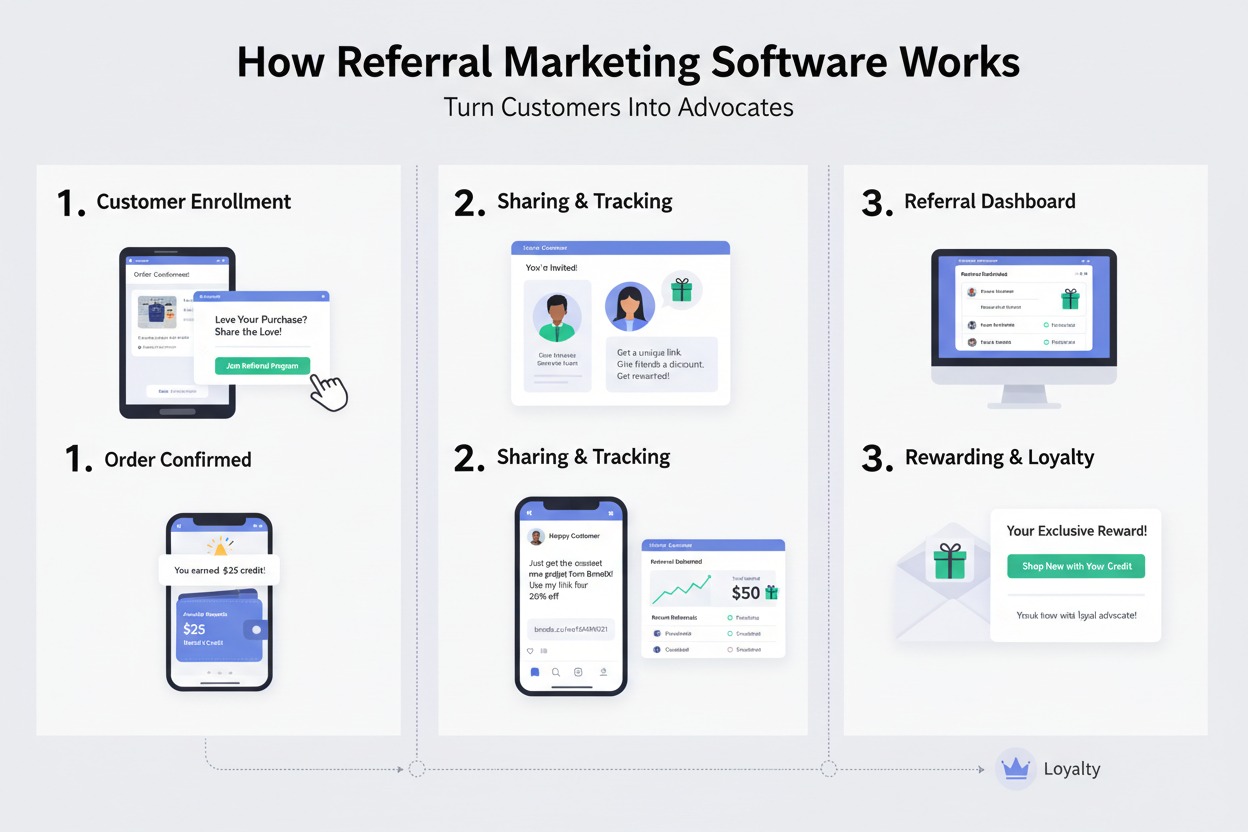
Referral marketing platforms operate through a combination of unique identifier technology, automated workflow triggers, and integration APIs that connect the referral programme to your broader business infrastructure. Understanding the mechanics helps you configure programmes more effectively and troubleshoot issues when they arise.
“The best referral systems are invisible to the end user — they make sharing feel natural, rewarding, and effortless rather than transactional.” — Jay Baer, Marketing Strategist
The Step-by-Step Referral Journey
While platforms differ in their interfaces and feature sets, the underlying referral journey follows a consistent sequence of events. Here is how a typical referral programme flows from start to finish:
- Customer enrolment — An existing customer is invited to join the referral programme, typically via a post-purchase email, an in-app prompt, or a dedicated landing page. They accept and receive a unique referral link or code tied to their account.
- Sharing the referral — The participant shares their link through their preferred channel — email, WhatsApp, Instagram, or direct message — to friends, family, or followers who may be interested in the product or service.
- New visitor arrives — The referred prospect clicks the link and lands on the business website. The platform’s tracking cookie or UTM parameter records the referral source, associating the visit with the original referrer.
- Conversion event occurs — The new visitor completes the desired action, such as making a purchase or signing up for a free trial. The platform detects this conversion and validates it against the programme’s eligibility rules.
- Reward fulfilment — Once validated, the platform automatically triggers rewards for the referrer, the new customer, or both — depending on the programme structure configured by the business.
- Reporting and optimisation — The conversion is logged in the analytics dashboard, contributing to performance data that informs future programme adjustments.
Integration with Your Existing Marketing Stack
For referral software to deliver maximum value, it must connect seamlessly with the tools your business already uses. Integration capability is therefore a non-negotiable consideration when evaluating platforms.
Most leading referral platforms offer native integrations with popular e-commerce platforms such as Shopify, WooCommerce, and BigCommerce, as well as email marketing tools like Klaviyo and Mailchimp, CRM systems such as HubSpot and Salesforce, and payment processors including Stripe and PayPal. These connections allow referral prompts to be embedded within post-purchase email flows, customer account pages, and onboarding sequences — placing the invitation precisely where customer satisfaction is highest.
For businesses with more complex needs, webhook support and REST API access enable custom integrations with proprietary systems. This flexibility ensures that even as your marketing stack evolves, your referral programme can adapt without requiring a platform migration.
Top Factors to Consider When Choosing Referral Software
With a growing number of platforms on the market, selecting the right solution requires a structured evaluation approach. The decision should be driven by your specific business model, your technical capabilities, the size of your customer base, and the complexity of the referral programme you intend to run.
The most important factors to assess are:
- Programme flexibility — Can you customise reward types, eligibility rules, and referral triggers to match your specific acquisition goals?
- Integration depth — Does the platform connect natively with your e-commerce platform, email tool, and CRM without requiring extensive development work?
- Fraud prevention — What mechanisms are in place to detect and block programme abuse, including self-referrals and fake account creation?
- Customer support quality — Is responsive, knowledgeable support available during your onboarding phase and beyond?
- Data ownership and privacy compliance — Does the platform comply with GDPR and provide clear policies on how participant data is stored and used?
Scalability and Pricing Models
Pricing structures vary considerably across referral platforms, and choosing a model that aligns with your growth trajectory is essential to avoiding cost surprises as your programme scales.
| Platform | Pricing Model | Starting Price | Best Suited For |
|---|---|---|---|
| Upviral | Subscription tiers | £75/month | Marketing teams, campaign managers and small business owners |
| Friendbuy | Subscription tiers | Custom pricing | Mid-market and enterprise brands |
| Referral Rock | Flat monthly subscription | £175/month | B2B and service businesses |
| Viral Loops | Template-based tiers | £35/month | Campaign-focused growth teams |
| Tapfiliate | Per-referral or flat fee | £59/month | Agencies and SaaS businesses |
When evaluating scalability, consider not only the current cost but how pricing changes as your referral volume grows. Some platforms charge per conversion or take a percentage of referred revenue, which can become expensive at high volumes. Others offer flat-rate plans that become more cost-effective as programme activity increases.
Discover the power of UpViral Futures, the ultimate tool for boosting your online campaigns and growing your audience effortlessly. Start your 14-day trial today and experience the benefits first hand—no risk, just results! Sign up here to get started.
Ease of Use and Customisation Options
For small business owners and Shopify merchants without dedicated development resources, ease of use is often the deciding factor between two otherwise comparable platforms. A programme that cannot be launched and maintained without technical expertise will quickly become a burden rather than a growth asset.
Look for platforms that offer no-code setup wizards, pre-built templates for common programme types, and intuitive dashboards that surface key metrics without requiring data analysis expertise. At the same time, ensure that the platform does not sacrifice customisation depth for simplicity — the ability to match the programme’s visual design to your brand and adjust messaging for different customer segments is important for maintaining a professional, on-brand experience throughout the referral journey.
Common Misconceptions About Referral Marketing Software
“The biggest barrier to referral programme success is not technology — it is the false assumptions businesses bring to the table before they even begin.” — Tiffany Bova, Growth Evangelist at Salesforce
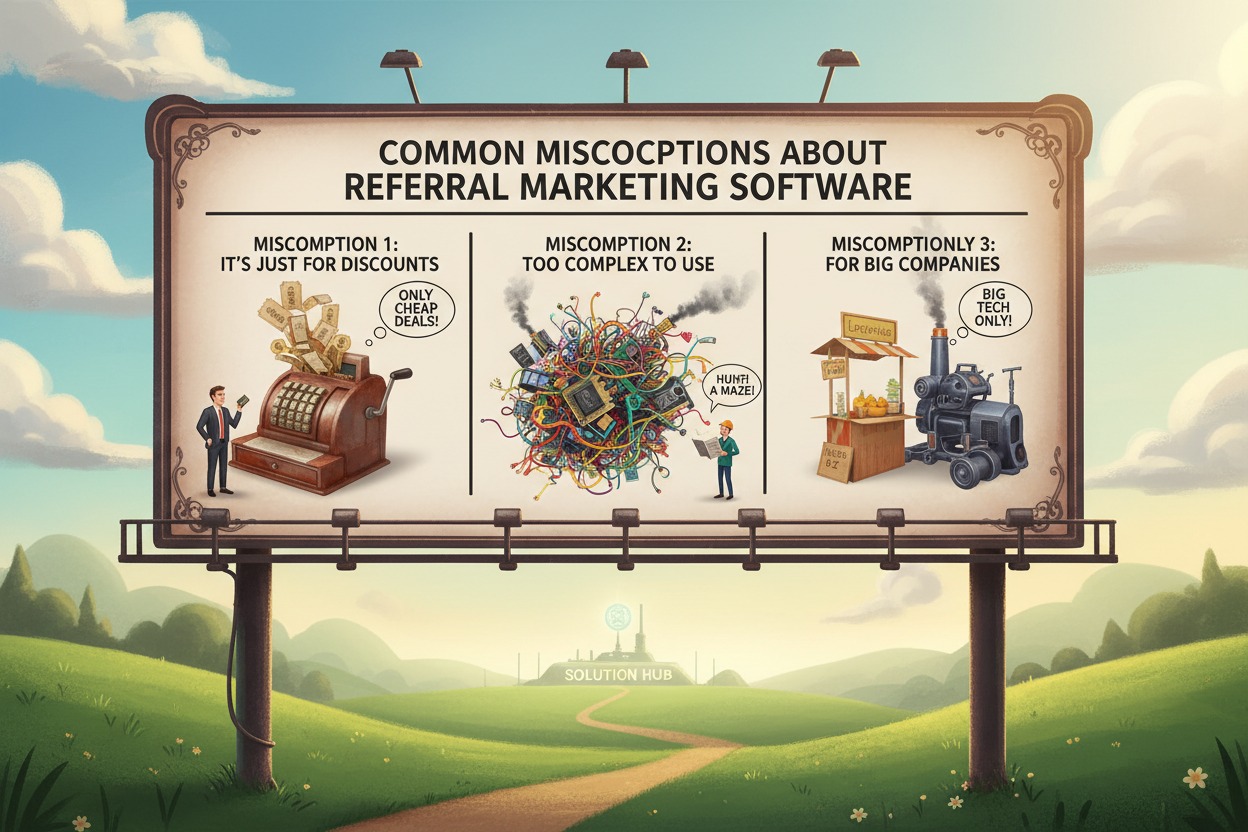
Referral marketing is widely discussed, yet frequently misunderstood. These misconceptions lead businesses to either dismiss referral programmes prematurely or launch them with unrealistic expectations — both of which result in missed growth opportunities.
One of the most persistent myths is that referral programmes only work for large, established brands with massive customer bases. In reality, smaller businesses often see stronger referral performance precisely because their customer relationships are more personal. A loyal base of even a few hundred satisfied customers can generate meaningful referral activity when the right incentive structure is in place.
Another common misconception is that referral software is prohibitively expensive or technically complex to implement. While enterprise-grade platforms do carry higher price points, solutions such as ReferralCandy and Viral Loops are specifically designed for small businesses and Shopify merchants, offering no-code setup at accessible price tiers. Most modern platforms can be configured and launched within a single working day.
Some business owners assume that simply having a referral programme guarantees results. In practice, programme visibility is a critical variable that is often overlooked. A referral programme that is buried in a footer link or mentioned once in a welcome email will generate minimal participation. Consistent promotion through post-purchase flows, account dashboards, and seasonal campaigns is what sustains engagement over time.
There is also a widespread belief that cash rewards are always the most effective incentive. Research consistently shows that contextually relevant rewards — such as store credit, exclusive products, or service upgrades — often outperform cash equivalents, particularly when they reinforce the customer’s existing relationship with the brand. The optimal reward type depends heavily on your audience and average transaction value.
Finally, many businesses treat referral programmes as a set-and-forget channel. In reality, the most successful programmes are actively managed — with regular reviews of conversion data, reward adjustments based on performance, and periodic re-engagement campaigns targeting dormant referrers. Referral software provides the infrastructure, but sustained results require ongoing strategic attention.
Important Considerations Before You Launch a Referral Programme
Before selecting a platform and going live, there are several foundational decisions that will significantly influence whether your referral programme succeeds or stalls. Rushing this planning phase is one of the most common reasons programmes underperform despite having capable software in place.
The first consideration is product-market fit and customer satisfaction. Referral programmes amplify what already exists — if your customers are not genuinely satisfied with their experience, no incentive will motivate them to put their personal reputation on the line by recommending your brand. Before launching, assess your Net Promoter Score or gather customer feedback to confirm that the conditions for organic advocacy are present.
Next, define your programme objectives with specificity. Are you primarily targeting new customer acquisition, increasing average order frequency, or expanding into a new demographic? Your goal determines the reward structure, the eligibility rules, and the metrics you will use to evaluate success. A programme designed to drive first-time purchases looks very different from one built to reward repeat referrers.
Legal and compliance requirements must also be addressed before launch. In the United Kingdom, referral programmes that involve financial incentives are subject to consumer protection regulations and, in some sectors, financial promotion rules. Ensure that your programme terms are clearly written, that reward conditions are transparent, and that participant data is handled in accordance with GDPR. Your referral platform should support compliant data practices, but the responsibility for programme legality rests with your business.
Consider your reward budget carefully before committing to an incentive structure. Calculate the maximum allowable cost per referred acquisition based on your customer lifetime value and margin, then design rewards that remain profitable at scale. A reward that is too generous may drive short-term participation but erode margins; one that is too modest will fail to motivate sharing.
Finally, plan your promotion strategy before the programme goes live. Identify the touchpoints where referral invitations will appear — post-purchase confirmation pages, transactional emails, customer account portals, and social media — and ensure that each touchpoint communicates the programme clearly and compellingly. The best referral marketing software cannot compensate for a programme that customers never discover.
Taking the time to address these considerations before launch dramatically improves the likelihood of building a programme that delivers sustainable, measurable growth from day one.
Conclusion
Referral marketing has earned its place as one of the most reliable and cost-effective growth channels available to businesses of any size. The combination of personal trust, built-in social proof, and measurable attribution makes it uniquely powerful in an environment where paid acquisition costs continue to climb and consumer scepticism is at an all-time high.
The best referral marketing software transforms what was once a manual, unpredictable process into a structured, scalable programme that works continuously alongside your existing marketing efforts. From automated reward fulfilment and fraud detection to deep integration with tools like Klaviyo, Shopify, and HubSpot, today’s platforms provide everything needed to run a professional referral operation without requiring a dedicated technical team.
Choosing the right platform comes down to understanding your specific business needs — your customer base, your reward budget, your technical capabilities, and your growth objectives. Whether you are a Shopify merchant exploring ReferralCandy, a SaaS business evaluating Referral Rock, or a growth-focused brand considering Friendbuy, the principles remain consistent: make sharing easy, make rewards meaningful, and make the data work for you.
Approach your referral programme as a long-term growth asset rather than a short-term campaign, and invest the time to plan, promote, and optimise it properly. The businesses that do will find that their most satisfied customers become their most effective and enduring acquisition channel.
UpViral may come with a higher price tag compared to many other platforms, but its starter plan is packed with a wealth of features that far exceed what most competitors offer at the entry level. This powerful combination of advanced tools and comprehensive capabilities means you get exceptional value right from the start, empowering you to create highly effective and engaging campaigns without needing to upgrade immediately.
For users who are serious about growing their audience, boosting engagement, and maximizing their marketing impact, UpViral is truly a smart investment. The extra cost is justified by the superior functionality, ease of use, and the potential for greater returns on your marketing efforts, making it the preferred choice for businesses that demand more from their promotional tools. Choosing UpViral means choosing a platform that delivers not just features, but real results that help your business grow faster and more efficiently.
If you’re looking to boost your business growth, I highly recommend starting with their 14-day free trial to experience first hand how effective this tool can be in driving engagement and sales.
Frequently Asked Questions
What is the best referral marketing software for small businesses?
For small businesses, Upviral and Viral Loops are consistently among the strongest options. Both offer accessible pricing, no-code setup, and native Shopify integration, making them practical choices for merchants without dedicated development resources. The best fit ultimately depends on your reward structure preferences and the volume of referrals you anticipate. If you are running a service-based business rather than an e-commerce store, Upviral is worth evaluating for its flexibility with non-transactional referral triggers.
How much does referral marketing software typically cost?
Pricing varies considerably depending on the platform and your programme’s scale. Entry-level plans from providers such as Viral Loops begin around £35 per month, while mid-range platforms like Upviral start closer to £75 per month. Enterprise-focused solutions such as Friendbuy use custom pricing based on referral volume and feature requirements. When budgeting, account for both the subscription cost and any per-conversion fees, as these can accumulate quickly in high-volume programmes.
How long does it take to set up a referral programme?
Most modern referral platforms are designed for rapid deployment. With a no-code platform and a clear incentive structure already decided, a basic programme can be configured and launched within a single working day. More complex programmes — those requiring custom integrations with a CRM, bespoke reward logic, or multi-language support — may take several days to a week to implement properly. Investing time in the planning phase before touching the software significantly reduces the setup period and the likelihood of needing to reconfigure rules after launch.
Do referral programmes work for B2B businesses?
Yes, referral programmes are highly effective in B2B contexts, though the programme design differs from consumer-facing models. B2B referral cycles are typically longer, incentives are often monetary or service-based rather than discount-driven, and the pool of potential referrers is smaller but carries greater influence. Platforms such as Referral Rock and Tapfiliate are specifically well-suited to B2B use cases, offering the flexibility to manage relationship-based referrals and longer attribution windows that reflect extended sales cycles.
How do I prevent fraud in my referral programme?
Fraud prevention begins with choosing a platform that includes built-in detection mechanisms — specifically, the ability to identify self-referrals, flag duplicate accounts using the same device or IP address, and enforce minimum qualifying criteria before rewards are issued. Beyond platform-level controls, setting a minimum order value or a waiting period before rewards are released reduces the incentive for abuse. Regularly reviewing your referral data for unusual patterns — such as a single referrer generating a disproportionate share of low-value conversions — allows you to catch and address fraudulent activity before it significantly impacts your programme budget.
Leave a Reply