
Table of Contents
“Word of mouth is the most powerful form of marketing — the challenge has always been making it scalable. UpViral solves that problem.”
Growing a business in today’s crowded digital landscape requires more than paid ads and social media posts. It demands a strategy that turns your existing audience into an active, motivated sales force. That is precisely where viral referral marketing comes into play — and why this UpViral tutorial exists.
UpViral is a dedicated referral campaign platform that empowers businesses to build and launch viral giveaways, waitlists, and referral programmes without needing a development team or a large marketing budget. Whether you are running a Shopify store, managing a growing content brand, or scaling a marketing agency, UpViral gives you the infrastructure to grow your audience exponentially through the power of peer-to-peer sharing.
This step-by-step guide is designed specifically for beginners. You do not need prior experience with referral software or growth hacking strategies to follow along. By the end of this tutorial, you will understand how UpViral works, how to set up your first campaign, and how to measure the results that matter most.
Organic growth is no longer a slow, unpredictable process when you have the right tools in place. UpViral puts a proven system behind your referral efforts, giving you full control over incentives, tracking, and participant experience. The sections ahead cover everything from platform fundamentals to dashboard analytics, campaign customisation, and common mistakes to avoid. Let us begin.
What Is UpViral?
UpViral is a cloud-based referral marketing platform that enables businesses to create viral campaigns driven by incentives and social sharing. Founded by Wilco de Kreij, the platform was built on a straightforward premise: people are far more likely to take action — whether signing up, purchasing, or sharing — when they are rewarded for doing so and when their friends are involved in the process.
At its core, UpViral allows you to build campaigns where each new participant receives a unique referral link. When they share that link and their contacts sign up or complete a desired action, both parties can earn points, entries, or rewards. This creates a self-perpetuating loop of growth that traditional advertising simply cannot replicate.
| Feature | Details |
|---|---|
| Campaign Types | Giveaways, waitlists, sweepstakes, referral programmes |
| Integrations | Mailchimp, ActiveCampaign, ConvertKit, Zapier, HubSpot |
| Customisation | Fully branded landing pages, email sequences, reward tiers |
| Analytics | Real-time dashboard with referral tracking and conversion data |
| Pricing | Starter, Business, and Premium plans available |
| Free Trial | 14-day free trial with full feature access |
Referral tracking, reward automation, and campaign analytics are the three pillars that make UpViral a complete solution rather than just a landing page builder. The platform handles the technical complexity so that you can focus entirely on your offer and your audience.
Read the full UpViral review to discover how this powerful marketing tool can help you grow your email list and boost your online presence. The review covers all key features, benefits, pricing, and user experiences, giving you a comprehensive understanding of whether UpViral is the right choice for your business. Don’t miss out on expert insights and practical tips to maximize your campaign success. Click the link to get the complete UpViral review now!
How UpViral Differs From Other Referral Platforms
Several referral tools exist in the market — ReferralCandy, Viral Loops, and Ambassador are among the most commonly compared alternatives. What sets UpViral apart is its combination of simplicity and depth. Most competing platforms are either too basic for serious marketers or too technically demanding for small business owners.
UpViral sits in the middle ground. It offers advanced features such as multi-step reward tiers, fraud detection, and deep email automation integrations, while keeping the setup process accessible enough for a complete beginner to launch a campaign within a single afternoon. The platform also places a strong emphasis on list building, making it particularly valuable for businesses whose primary goal is growing an engaged email subscriber base rather than simply driving one-off purchases.
Another key differentiator is UpViral’s focus on gamification. Participants are shown a leaderboard of top referrers, which introduces a competitive element that drives sustained sharing behaviour long after the initial campaign launch.
Who Should Use UpViral?
UpViral is well-suited to a broad range of business types, but it delivers the greatest return for those with an existing audience — however small — and a compelling offer to promote. Specifically, the platform is an excellent fit for:
Shopify store owners looking to grow their customer base before or after a product launch. Small business owners who want to reduce their reliance on paid advertising. Influencers and content creators building an email list or promoting a digital product. Marketing agencies managing growth campaigns on behalf of multiple clients. Growth-focused brands in competitive niches where word-of-mouth carries significant social proof.
If you have something valuable to offer and want to put a scalable system behind its promotion, this UpViral tutorial will show you exactly how to do it.
Why UpViral Matters for Your Business Growth
“Referred customers are four times more likely to refer others — making every single referral campaign an investment that compounds over time.”
Referral marketing is not a new concept, but the ability to run it at scale with full tracking and automation is a relatively recent development. UpViral brings that capability to businesses of every size, which is why understanding the platform is increasingly important for anyone serious about sustainable growth.
The Business Case for Viral Referral Marketing
The economics of referral marketing are difficult to argue with. Acquiring a new customer through paid channels — Google Ads, Meta Ads, influencer partnerships — carries an ever-increasing cost per acquisition. Referral programmes, by contrast, leverage your existing audience to bring in new customers at a fraction of that cost.
Consider the following reasons why referral marketing deserves a central place in your growth strategy:
- Referred customers have a 16% higher lifetime value than customers acquired through other channels, according to research published in the Journal of Marketing.
- Referral leads convert at a rate approximately 30% higher than leads generated through paid advertising.
- Word-of-mouth influences approximately 90% of purchasing decisions, even when the final conversion happens through another channel.
- Referral programmes reduce churn rate because customers who arrive through trusted recommendations tend to be more loyal and more engaged.
- Viral campaigns create compounding growth — each new participant has the potential to bring in additional participants, meaning your audience can grow exponentially rather than linearly.
- UpViral’s built-in fraud detection ensures that your campaign rewards genuine referrals rather than gaming attempts, protecting your budget and your data integrity.
Real-World Results Brands Have Achieved
The impact of well-executed referral campaigns is well-documented across industries. Dropbox famously grew its user base by 3,900% in 15 months through a referral programme that rewarded both the referrer and the new user with additional storage space. Harry’s, the shaving brand, used a pre-launch referral campaign to collect 100,000 email subscribers in just one week before their store even opened.
Closer to the UpViral ecosystem, businesses using the platform have reported list growth rates of 200% to 400% compared to standard opt-in campaigns run during the same period. A conversion-optimised referral campaign on UpViral typically outperforms a standard lead magnet because participants are actively motivated to share — turning passive subscribers into enthusiastic advocates.
The compounding effect of referral marketing means that even a modest initial audience can generate remarkable results when the right incentive structure and sharing mechanics are in place. That is the foundation this UpViral tutorial is built upon.
Key Components of an UpViral Campaign
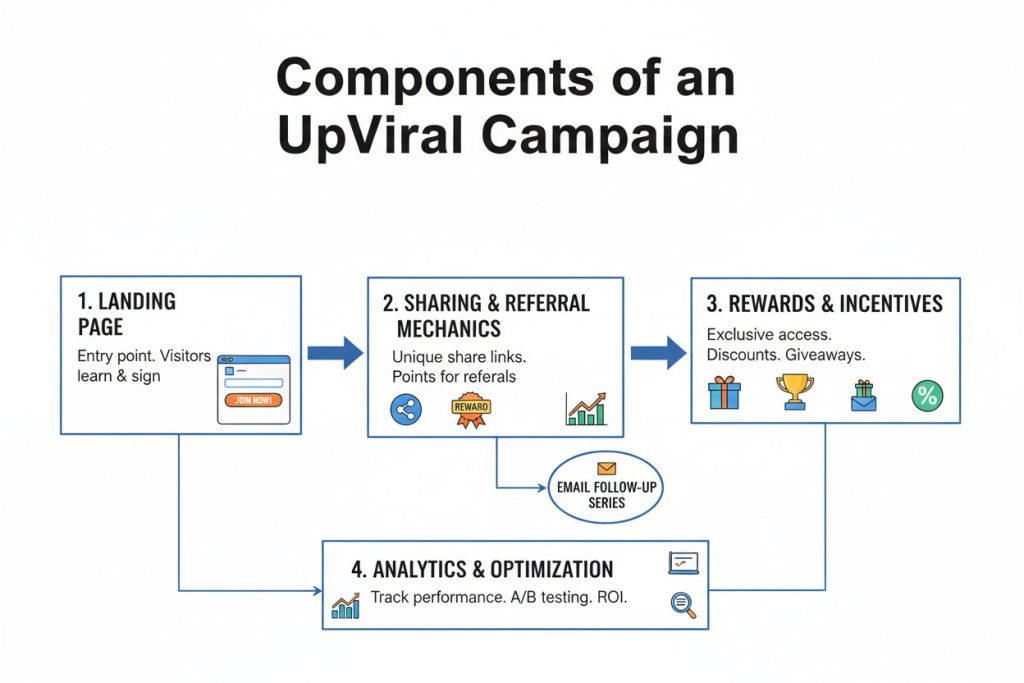
Every successful referral campaign is built on a set of interconnected components that work together to attract participants, motivate sharing, and deliver measurable results. Understanding these components before you launch is what separates a high-performing campaign from one that generates a handful of sign-ups and stalls.
| Component | Purpose | Example Use |
|---|---|---|
| Landing Page | Captures initial sign-ups and communicates the offer | Giveaway entry page for a product launch |
| Referral Link | Unique URL assigned to each participant for tracking | Shared via email, social media, or messaging apps |
| Reward System | Incentivises sharing by offering points, entries, or prizes | Extra contest entries for each successful referral |
| Email Sequences | Nurtures participants and reminds them to share | Automated follow-up with referral link and progress update |
| Fraud Detection | Prevents fake referrals from distorting results | Flags suspicious IP addresses and duplicate entries |
| Analytics Dashboard | Tracks campaign performance in real time | Monitors conversions, shares, and top referrers |
Referral mechanics, incentive architecture, and participant journey are the three design principles that underpin every component listed above. Getting each one right is what transforms a basic campaign into a viral growth engine.
Exploring the 14-day trial allows you to experience first hand how UpViral can boost your marketing efforts without any initial commitment, giving you the opportunity to test its features and see the impact on your audience growth.
Campaign Types Available on UpViral
UpViral supports several distinct campaign formats, each suited to a different business objective. Choosing the right type from the outset ensures your campaign is aligned with your goals rather than working against them.
Giveaway campaigns are the most widely used format on the platform. Participants enter by providing their email address and are then encouraged to refer friends in exchange for additional entries. This format works exceptionally well for product launches, seasonal promotions, and audience building.
Waitlist campaigns are designed for pre-launch scenarios. Participants join a waiting list and move up the queue by referring others — a format that builds anticipation, creates urgency, and rewards your most engaged early adopters. This is the format Harry’s used to spectacular effect before their store launch.
Sweepstakes campaigns operate similarly to giveaways but are typically structured around a single prize draw with a defined end date, making them ideal for time-sensitive promotions.
Referral reward campaigns move away from prize-based incentives entirely, instead offering participants a tangible benefit — such as a discount code, free resource, or exclusive access — for each person they successfully refer. This format tends to attract a more conversion-focused audience.
Reward Structures and Incentive Options
The reward structure you choose will directly influence how aggressively participants share your campaign. UpViral gives you considerable flexibility here, allowing you to design incentives that match your audience’s motivations and your business’s capacity to deliver.
Points-based rewards allow participants to accumulate points with each referral, which can then be redeemed for prizes or perks at defined thresholds. This structure encourages ongoing engagement rather than a single share. Milestone rewards unlock specific prizes when a participant reaches a set number of referrals — for example, referring three friends earns a discount code, while referring ten earns a free product.
Leaderboard-based rewards introduce a competitive dynamic by publicly ranking the top referrers and offering premium prizes to those at the top. This format is particularly effective for audiences with a strong community identity, such as fitness brands, gaming communities, or creator audiences.
When designing your incentive structure, the most important principle is to ensure the reward is genuinely desirable to your target audience and proportionate to the effort required to earn it. An offer that is too modest will fail to motivate sharing, while one that is too generous may attract low-quality participants motivated purely by the prize rather than genuine interest in your brand.
How UpViral Works: The Step-by-Step Setup Process
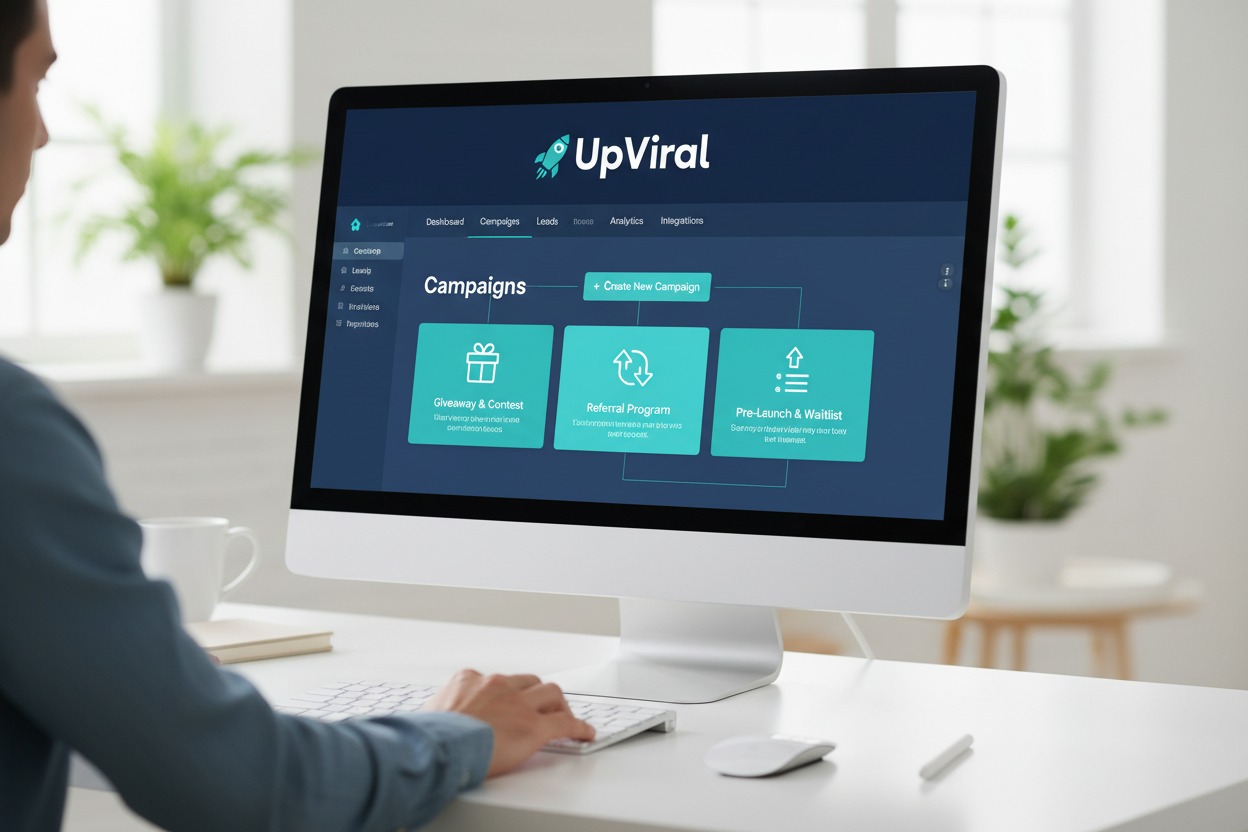
Getting started with UpViral is more straightforward than many beginners expect. The platform has been deliberately designed to guide new users through the campaign creation process without requiring technical expertise or prior experience with referral software.
- Create your UpViral account and select your plan or activate the 14-day free trial.
- Click “New Campaign” from your dashboard and choose your campaign type — giveaway, waitlist, sweepstakes, or referral reward.
- Define your campaign goal, set the start and end dates, and configure your basic campaign settings including the campaign name and primary offer.
- Build and customise your landing page using UpViral’s drag-and-drop editor, adding your branding, imagery, copy, and call-to-action.
- Set up your reward tiers, specifying what participants earn at each referral milestone and how rewards will be delivered.
- Configure your email sequences, including the confirmation email, referral reminder, and winner notification templates.
- Publish your campaign and share the landing page URL across your chosen marketing channels to drive initial traffic.
“The first 48 hours of a referral campaign are the most critical — the participants who sign up earliest are statistically the most likely to share, so your initial traffic push sets the trajectory for everything that follows.”
Creating Your First Campaign From Scratch
After logging into your UpViral account, navigate to the campaign creation wizard by clicking the “New Campaign” button on your main dashboard. You will be prompted to select a campaign type — for most beginners, a giveaway campaign is the recommended starting point because it offers the clearest value exchange and the most straightforward setup process.
Next, you will name your campaign and define the core offer. Be specific here. “Win a £500 skincare bundle” will outperform “Win a prize” every single time because specificity communicates value and attracts the right audience. Set your campaign duration — typically between seven and 21 days for optimal momentum — and move on to the landing page builder.
Customising Your Landing Page and Share Settings
UpViral’s landing page editor is built around a template system that gives you a professional starting point without requiring design skills. Select a template that matches your campaign type, then customise it with your brand colours, logo, headline, supporting copy, and any imagery relevant to your offer.
Pay particular attention to your headline. This is the single most important element on your landing page and should communicate the prize or reward, the action required to enter, and a reason to act now — ideally within a single sentence. Once your landing page is configured, move to the share settings panel, where you can customise the message and image that appear when participants share their referral link on social media platforms including Facebook, Twitter, and WhatsApp.
Setting Up Rewards and Tracking Referrals
Within the rewards section of your campaign builder, define the milestones at which participants unlock prizes or perks. For each milestone, specify the reward type — whether that is a digital download, a discount code generated automatically by UpViral, or a physical prize you will fulfil manually — and write the reward notification email that participants will receive upon reaching that threshold.
UpViral automatically generates a unique referral link for every participant upon sign-up. The platform tracks all referral activity associated with each link in real time, attributing conversions accurately and flagging any suspicious activity through its built-in fraud detection system. You do not need to configure any tracking codes manually — the system handles this entirely in the background.
Understanding UpViral’s Dashboard and Analytics
Once your campaign is live, the UpViral dashboard becomes your primary tool for monitoring performance, identifying opportunities, and making data-informed decisions. Data literacy is a critical skill for any marketer running referral campaigns, and UpViral’s analytics interface is designed to make that as accessible as possible.
| Metric | What It Measures | Why It Matters |
|---|---|---|
| Total Leads | Number of participants who have signed up | Indicates overall campaign reach |
| Referral Rate | Percentage of participants who have referred at least one person | Measures how effectively your incentive drives sharing |
| Viral Coefficient | Average number of new sign-ups generated per participant | Determines whether the campaign is self-sustaining |
| Top Referrers | Participants ranked by number of successful referrals | Identifies brand advocates for future engagement |
| Conversion Rate | Percentage of landing page visitors who sign up | Reveals landing page effectiveness |
| Shares by Channel | Breakdown of referral link shares by platform | Shows where your audience is most active |
Viral coefficient is arguably the most important metric to understand. A viral coefficient above 1.0 means that each participant is, on average, bringing in more than one additional participant — which is the mathematical definition of a self-sustaining viral campaign.
Key Metrics to Monitor During Your Campaign
Checking your dashboard daily during an active campaign allows you to respond quickly to performance trends rather than waiting until the campaign ends to evaluate what worked. The following metrics deserve your closest attention throughout the campaign lifecycle:
- Monitor your referral rate daily — if fewer than 20% of participants are sharing their link, your reward may need to be adjusted or your reminder email sequence strengthened.
- Track your viral coefficient every 48 hours to determine whether the campaign is gaining or losing momentum.
- Review your top referrers list and consider reaching out to your highest performers with an additional incentive to sustain their activity.
- Analyse shares by channel to identify which platform is driving the most referral traffic, then concentrate your promotional efforts on that channel.
- Watch your conversion rate on the landing page — a rate below 25% typically signals that your headline, offer, or page design needs refinement.
Segmentation data within the dashboard also allows you to compare the behaviour of referred participants versus those who discovered your campaign through direct traffic. Referred participants typically show higher engagement rates and stronger sharing behaviour, which validates the compounding nature of well-structured referral campaigns.
Common Misconceptions About UpViral and Viral Campaigns
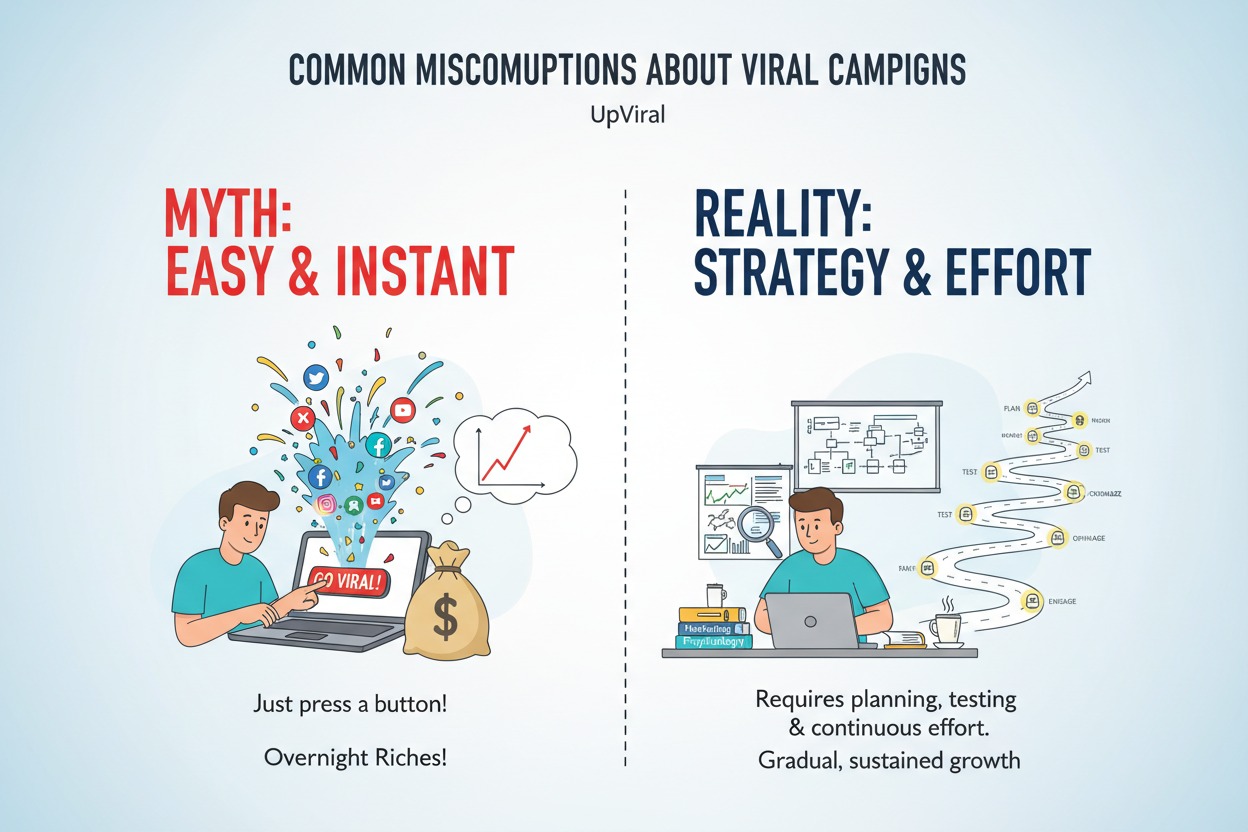
“The biggest barrier to launching a referral campaign is not technical complexity — it is the false belief that viral growth only happens to brands that are already large enough to deserve it.”
Several myths surround both UpViral specifically and viral referral marketing in general. These misconceptions cause businesses to delay launching campaigns, underinvest in their incentive structures, or abandon the approach entirely after a single underwhelming attempt. Addressing them directly is essential before you commit to your first campaign.
Misconception one: You need a large existing audience for a referral campaign to work. This is perhaps the most damaging myth in the referral marketing space. In reality, UpViral campaigns have been used successfully by brands with fewer than 500 email subscribers. The compounding mechanics of referral marketing mean that even a small initial audience can generate disproportionate growth, provided the offer is compelling and the sharing friction is low. Starting small is not a disadvantage — it is simply a starting point.
Misconception two: Viral campaigns are unpredictable and impossible to manage. While no campaign outcome can be guaranteed, UpViral gives you a significant degree of control over the variables that determine performance. Your landing page copy, reward structure, email sequences, and promotional channels are all within your control. The platform’s real-time analytics allow you to identify underperformance early and make adjustments mid-campaign rather than waiting for a post-mortem.
Misconception three: Referral participants are low-quality leads who only sign up for prizes. This concern is understandable but largely unfounded when your campaign is designed correctly. Incentive alignment — matching your reward to your actual product or service — naturally filters for relevant participants. A fitness brand offering a free training programme as a reward will attract fitness enthusiasts, not bargain hunters. The quality of your leads is a direct reflection of the quality and relevance of your offer.
Misconception four: UpViral is only useful for e-commerce businesses. While Shopify store owners represent a significant portion of the platform’s user base, UpViral is equally effective for service-based businesses, content creators, SaaS companies, and marketing agencies. Any business model that benefits from a growing email list or an expanded customer base can leverage the platform’s capabilities. The campaign type and reward structure simply need to be adapted to fit the context.
Recognising these misconceptions for what they are — barriers built on incomplete information rather than evidence — is the first step towards launching a campaign with genuine confidence.
Conclusion
This UpViral tutorial has walked you through everything a beginner needs to understand the platform, build a campaign with confidence, and measure the results that matter. From the foundational mechanics of referral marketing to the specifics of reward structures, landing page customisation, and dashboard analytics, the path from zero to a live viral campaign is more accessible than most business owners initially assume.
The core principle behind UpViral is straightforward: people trust recommendations from people they know, and when you give them a reason to share, they will. The platform provides the infrastructure to make that sharing trackable, scalable, and repeatable — turning a behaviour that already happens organically into a structured growth channel you can rely on.
What separates successful campaigns from unsuccessful ones is rarely the platform itself. It is the clarity of the offer, the relevance of the reward, and the consistency of the follow-up. UpViral gives you the tools; your understanding of your audience determines how effectively you use them.
Whether you are building a pre-launch waitlist, running a seasonal giveaway, or creating a long-term referral programme for your Shopify store, the steps outlined in this guide provide a repeatable framework you can return to with every new campaign. Start with a single campaign, measure the results honestly, and iterate from there. Viral growth is not a matter of luck — it is a matter of system.
Exploring the 14-day trial allows you to experience first hand how UpViral can boost your marketing efforts without any initial commitment, giving you the opportunity to test its features and see the impact on your audience growth.
Frequently Asked Questions
Is UpViral suitable for complete beginners with no marketing experience?
Yes. UpViral has been designed with accessibility as a core priority. The campaign creation wizard guides you through each step sequentially, and the drag-and-drop landing page editor requires no coding or design skills. Most beginners are able to launch their first campaign within a few hours of creating an account. The 14-day free trial also means you can explore the full feature set without any financial commitment before deciding whether the platform suits your needs.
How much does UpViral cost after the free trial ends?
UpViral offers tiered pricing plans to accommodate different business sizes and campaign volumes. The Starter plan covers basic campaign functionality and is suitable for small businesses running occasional campaigns. The Business and Premium plans unlock additional features including higher participant limits, advanced integrations, and priority support. Pricing is subscription-based and billed monthly or annually, with annual billing offering a meaningful discount. Current pricing details are available directly on the UpViral website, as rates are subject to periodic updates. Read upviral pricing here.
Can I integrate UpViral with my existing email marketing platform?
Yes. UpViral integrates natively with a wide range of popular email marketing platforms including Mailchimp, ActiveCampaign, ConvertKit, and HubSpot. It also connects with Zapier, which opens up integrations with hundreds of additional tools. When a participant signs up for your campaign, their contact details can be automatically pushed to your chosen email platform, allowing you to add them to existing nurture sequences without any manual data handling.
What happens if participants try to game the system with fake referrals?
UpViral includes built-in fraud detection that monitors referral activity for suspicious patterns, including duplicate email addresses, shared IP addresses, and unusually rapid referral volumes. When the system identifies potentially fraudulent activity, those referrals are flagged rather than counted towards a participant’s total. This protects the integrity of your campaign data and ensures that rewards are delivered to genuine participants rather than those attempting to manipulate the results.
How long should a typical UpViral campaign run?
Most high-performing campaigns run for between seven and 21 days. Shorter campaigns of around seven to ten days create urgency and tend to generate a concentrated burst of sharing activity. Longer campaigns of up to 21 days allow more time for word-of-mouth to compound, but risk losing momentum in the middle period. Campaigns running longer than 30 days typically see diminishing engagement unless they are actively refreshed with new incentives or promotional pushes. For your first campaign, a ten to fourteen day window is a practical and manageable starting point.
Leave a Reply