Table of Contents
Introduction
“A giveaway without a strategy is just giving things away.” — Unknown
Running a successful giveaway campaign is one of the most powerful growth tactics available to modern marketers — but only when it’s done with intention. Whether you’re a Shopify store owner looking to build your email list, a SaaS founder trying to grow brand awareness, or a content creator aiming to explode your follower count, knowing how to run a viral giveaway campaign can be a genuine game-changer. Read Best Giveaway Software here.
The difference between a giveaway that fizzles out after 48 hours and one that generates thousands of leads often comes down to strategic planning, audience alignment, and smart distribution mechanics. It’s not about the size of your prize — it’s about how well you engineer the entire experience.
This step-by-step guide walks you through everything you need to know about how to run a viral giveaway campaign, from setting clear goals and choosing the right prize to building a high-converting landing page and promoting your campaign across multiple channels. By the end, you’ll have a repeatable framework for launching giveaways that don’t just attract attention — they drive measurable business results.
What You Need Before Launching a Viral Giveaway Campaign
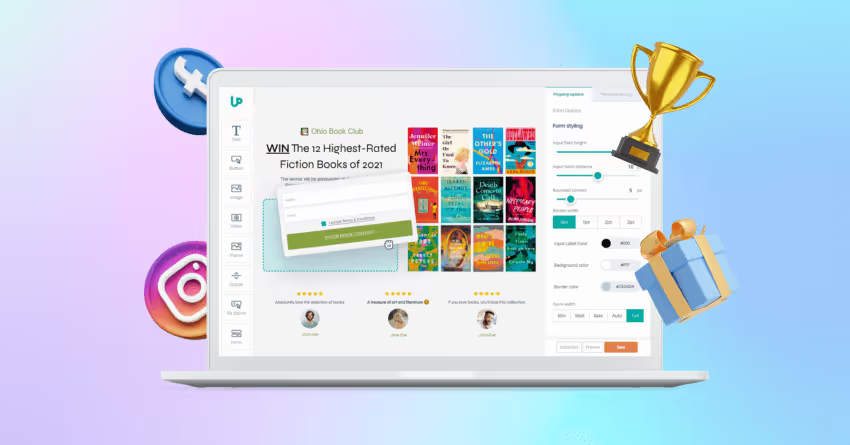
Before diving into the exciting parts of how to run a viral giveaway campaign, it’s essential to lay the proper groundwork. Skipping the preparation phase is the number one reason giveaway campaigns underperform. Getting your tools, budget, and infrastructure in place beforehand will save you significant time and prevent costly mistakes once your campaign goes live.
Essential Tools and Platforms
The right technology stack makes your campaign far easier to manage and scale. UpViral is among the most widely used giveaway platforms, offering built-in entry mechanics, fraud detection, social sharing features, and the ability to host landing pages on your own domain with SSL. You’ll also want an email marketing platform such as Klaviyo or Mailchimp to capture and nurture leads generated by the campaign.
Budget and Resource Planning
A realistic budget prevents overspending and helps you prioritise where your money delivers the most impact. Consider costs across four key areas: the prize itself, promotional spend, platform fees, and creative production.
| Budget Category | Estimated Cost Range | Notes |
|---|---|---|
| Prize / Product Value | £20-£50+ | Higher value increases participation rates |
| Giveaway Platform Fee | £0 – £150/month | Free tiers available on Gleam and KingSumo, Upviral offers advanced features for better results |
| Paid Promotion (Ads) | £100 – £1,500 | Facebook and Instagram ads perform well; with Upviral, you can run giveaways with no ads or minimal spend |
| Creative Production | £0 – £500 | DIY with Canva or hire a designer |
| Influencer Partnerships | £0 – £2,000 | Micro-influencers offer strong ROI but are not necessary |
Resource planning should also account for your team’s time. Assign clear ownership for campaign setup, social posting, customer support, and winner selection to avoid confusion mid-campaign.
Step 1: Define Your Giveaway Goals and Target Audience
The most viral giveaway campaigns share one thing in common: they were built around a specific goal. Without a defined objective, you risk attracting the wrong participants, collecting low-quality leads, and seeing zero long-term business impact.
- Grow your email subscriber list by a specific number within the campaign window.
- Increase social media followers on a target platform such as Instagram or TikTok.
- Drive traffic to a new product launch page or Shopify store.
- Generate user-generated content (UGC) around your brand or product.
- Boost brand awareness within a specific geographic or demographic segment.
- Re-engage dormant customers or lapsed email subscribers.
Setting Measurable Objectives
Every goal must be tied to a measurable metric. Instead of “gain more followers,” aim for “gain 2,000 Instagram followers within 14 days.” Using SMART goals (Specific, Measurable, Achievable, Relevant, Time-bound) ensures you can accurately evaluate performance after the campaign ends.
Identifying Your Ideal Participant
Your ideal participant is not “everyone.” Audience specificity is what separates a high-converting giveaway from a lead-generation disaster. Define your participant by age, interests, purchasing behaviour, and platform preference. A WooCommerce store selling fitness supplements should target health-conscious adults aged 22–40 who follow fitness influencers — not a broad general audience. The more targeted your participant profile, the higher your conversion quality post-campaign.
Step 2: Choose the Right Prize That Drives Participation
“The prize attracts the crowd, but the right prize attracts your customers.” — Growth Marketing Principle
Prize selection is arguably the most critical decision in your entire campaign. Choose something too generic — like a £500 Amazon gift card — and you’ll attract thousands of unqualified entrants who have zero interest in your brand. Choose something highly relevant, and you’ll draw in exactly the people most likely to become paying customers.
Matching the Prize to Your Audience
Your prize should feel irresistible to your ideal customer and largely irrelevant to everyone else. This natural filtering mechanism is one of the most underused tactics in giveaway marketing. A Shopify store selling premium coffee equipment should offer a high-end espresso machine bundle, not a generic cash prize. A SaaS founder targeting marketing agencies might offer a 12-month software subscription or an exclusive strategy session. The prize must reflect your brand’s core value proposition and speak directly to what your target audience genuinely wants.
Balancing Prize Value With Campaign Budget
Higher prize value doesn’t always mean better results — perceived value matters far more than monetary value. A curated bundle of your own products worth £150 can outperform a £500 unrelated prize because it pre-qualifies participants as genuine brand prospects. Aim to allocate roughly 30–50% of your total campaign budget to the prize itself. If you’re partnering with complementary brands — as Gymshark and MyProtein have done in co-branded campaigns — you can split prize costs while doubling your audience reach.
Step 3: Select Your Giveaway Format and Entry Mechanics
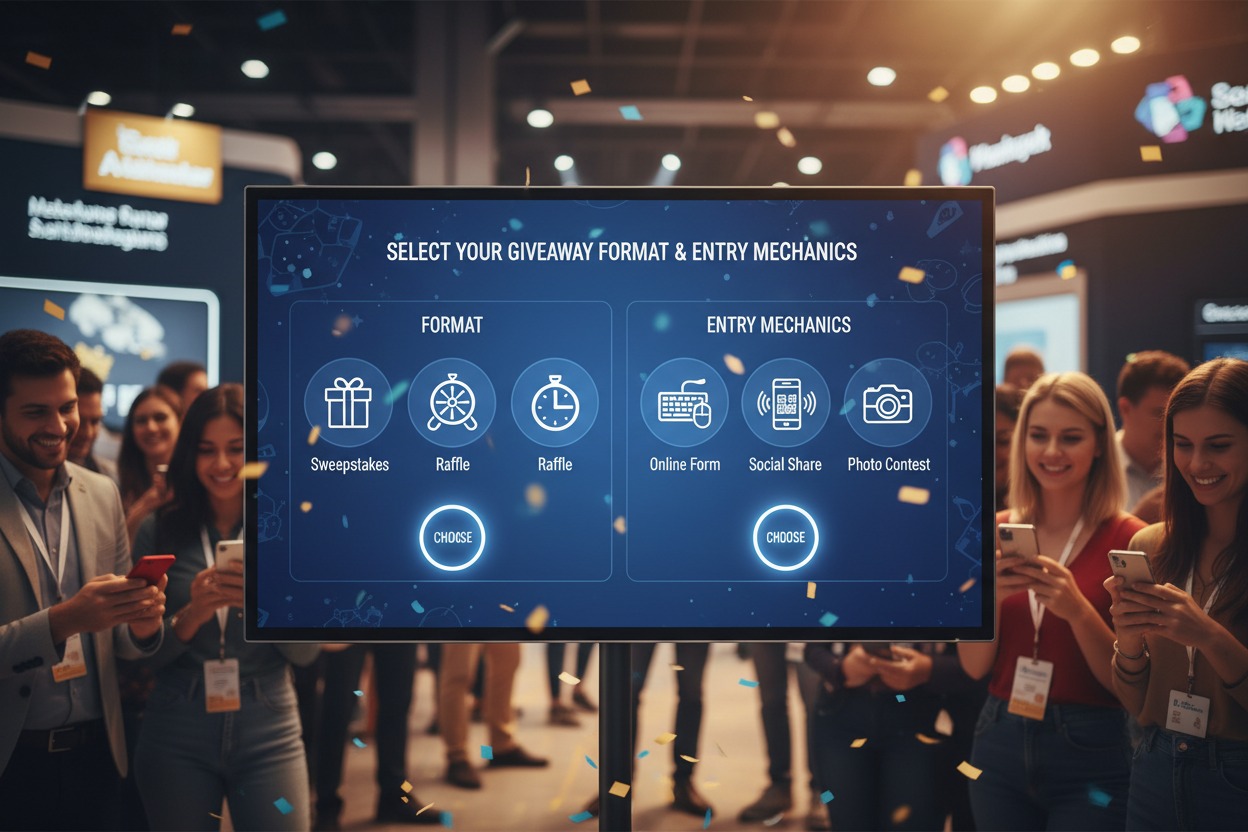
The format you choose determines how your campaign spreads, how many entries you collect, and ultimately, whether your giveaway achieves viral momentum. Different formats serve different goals, so aligning your mechanics with your objectives is non-negotiable. The entry actions you require directly influence both participation volume and the quality of engagement you receive.
Popular Giveaway Formats Compared
| Format | Best For | Virality Potential | Effort to Enter |
|---|---|---|---|
| Follow & Tag a Friend | Follower growth on Instagram/TikTok | High | Low |
| Refer-a-Friend (Viral Loop) | Email list building, lead generation | Very High | Medium |
| UGC Photo/Video Contest | Brand awareness, content creation | Medium | High |
| Quiz or Poll Entry | Audience segmentation, engagement | Medium | Low |
| Sweepstake (Random Draw) | Mass participation, broad reach | High | Very Low |
| Milestone Unlock | Progressive sharing, community building | Very High | Medium |
Choosing Entry Actions That Boost Virality
The most effective entry mechanics combine low-friction actions with built-in sharing incentives. Requiring participants to refer friends in exchange for bonus entries — a model popularised by tools like Upviral — creates an exponential growth loop. Every new entrant becomes a recruiter. Pairing this with a social share action (asking entrants to share the campaign on their Instagram Stories or X/Twitter feed) amplifies organic reach significantly. Avoid stacking too many mandatory entry steps; entry fatigue causes drop-offs. Limit required actions to two or three, then offer optional bonus entries for additional sharing behaviours. For more details, read our Upviral review here.
Step 4: Build and Launch Your Giveaway Landing Page
First impressions are everything in a giveaway campaign. Your landing page is the central hub where traffic converts into entries, and a poorly designed page can kill momentum even when your promotion is performing well. A high-converting giveaway page removes friction, builds excitement, and makes the entry process feel effortless.
Must-Have Elements on Your Giveaway Page
Every effective giveaway landing page needs a compelling headline that clearly states what’s being won, a high-quality image of the prize, and a concise description of how to enter. Include a visible countdown timer to create urgency, a clear list of entry steps, and your terms and conditions link for legal compliance. Social proof elements — such as the current number of entries — can significantly boost participation rates by triggering FOMO (fear of missing out).
Optimising for Mobile and Conversions
Over 70% of giveaway traffic typically arrives via mobile devices, making mobile optimisation non-negotiable. Use a single-column layout, large tap-friendly buttons, and minimal form fields. Platforms like Gleam.io and Unbounce offer mobile-responsive templates that load quickly and integrate directly with your email marketing tools. Test your page across multiple devices before launch, and use A/B testing on your headline and call-to-action button to maximise your entry conversion rate from day one.
Step 5: Promote Your Giveaway Across Multiple Channels
Launching your giveaway page is only half the battle. Without a deliberate promotion strategy, even the most beautifully designed campaign will struggle to gain traction. Distribution is where viral momentum is either built or lost.
- Announce the giveaway to your existing email list on day one to generate an immediate surge of entries.
- Post across all active social media profiles with platform-native content — Reels for Instagram, short-form video for TikTok.
- Partner with complementary brands or micro-influencers to tap into aligned audiences.
- Submit your giveaway to dedicated listing sites such as Giveaway Frenzy or Sweepstakes Advantage.
- Pin your giveaway post at the top of your social profiles for the campaign’s entire duration.
- Re-engage entrants mid-campaign with a reminder email highlighting the countdown and current entry numbers.
“The brands that win at giveaways aren’t the ones with the biggest budgets — they’re the ones who show up consistently across every channel.” — Digital Growth Strategist
Leveraging Social Media and Influencers
Social media amplification works best when you create platform-specific content rather than reposting identical assets everywhere. On Instagram, use Stories with countdown stickers and swipe-up links. On TikTok, create an authentic unboxing or prize reveal video. Partnering with micro-influencers — creators with 10,000–100,000 highly engaged followers — typically delivers stronger entry conversion rates than single mega-influencer posts, at a fraction of the cost.
Using Email Marketing and Paid Ads
Your existing email list is your most high-intent audience — activate them first. A well-crafted launch email with a clear subject line like “You could win [specific prize] — enter now” can drive hundreds of entries within hours. For paid promotion, Facebook Lead Ads and Instagram Story ads targeting lookalike audiences based on your customer list are consistently among the highest-performing formats for giveaway campaigns. Set a daily budget cap and monitor cost-per-entry closely to ensure your spend remains efficient throughout the campaign window.
Troubleshooting Common Giveaway Campaign Issues
Even well-planned campaigns encounter obstacles. Knowing how to diagnose and resolve problems quickly prevents small issues from derailing your entire campaign.
Low entry volume is the most common issue and usually signals a promotion gap rather than a prize problem. Revisit your distribution channels, increase posting frequency, and consider activating a paid ad campaign if organic reach is underperforming. If entries are high but email open rates post-campaign are poor, your prize likely attracted unqualified participants — a targeting issue to address in future campaigns.
Fraudulent entries are a genuine concern, particularly in high-value giveaways. Platforms like Gleam.io include built-in fraud detection that flags suspicious behaviour such as duplicate IP addresses or bot-generated entries. Always review your entry list before announcing a winner and disqualify entries that don’t meet your stated terms.
If your referral loop isn’t generating shares, the incentive for bonus entries may not feel compelling enough. Test increasing the bonus entry value for referrals or simplifying the sharing process — every additional click in the sharing journey reduces completion rates.
Legal compliance issues can surface unexpectedly. Ensure your terms and conditions clearly state eligibility requirements, the prize description, entry deadlines, and winner selection method. In the UK, giveaways must distinguish between a prize competition (skill-based) and a free prize draw (random) to comply with the Gambling Act 2005. When in doubt, consult a legal professional before launch.
Pro Tips for Maximising Virality and Long-Term Results
The difference between a one-off giveaway and a repeatable growth engine lies in how you build and leverage the campaign beyond the entry period.
Upviral is a powerful tool that automates giveaways, making it easy to engage audiences and boost brand visibility. By streamlining the process of running contests, Upviral helps businesses grow their social media following organically. The platform encourages participants to share the giveaway with their networks, increasing reach and attracting new followers. With customizable templates and detailed analytics, Upviral enables marketers to optimize their campaigns and maximize growth efficiently.
Use a double opt-in confirmation for all email entries to ensure list quality and GDPR compliance. Subscribers acquired this way show measurably higher engagement than those added through single opt-in methods.
Segment your new subscribers immediately based on entry behaviour. Entrants who completed every bonus action — sharing on multiple platforms, referring friends — are your highest-intent prospects and deserve a dedicated nurture sequence.
Announce your winner publicly and document the handover with photos or video. This social proof builds trust for your next campaign and encourages previous entrants to participate again.
Repurpose your giveaway content. The UGC collected, the engagement data gathered, and the audience insights revealed all have long-term value. Use winning content in paid ads, testimonials on product pages, and audience data to refine future targeting.
Finally, run giveaways consistently rather than sporadically. Brands that schedule quarterly campaigns build an audience that anticipates and shares each new launch, compounding their reach with every iteration.
Conclusion
Learning how to run a viral giveaway campaign is one of the most valuable skills you can develop as a growth-focused marketer or business owner. When executed with intention — clear goals, a relevant prize, smart entry mechanics, and consistent multi-channel promotion — a giveaway campaign can deliver compounding results that extend well beyond the campaign window itself.
The framework outlined in this guide gives you everything you need on how to run a viral giveaway campaign: from pre-launch preparation and audience targeting to landing page optimisation, troubleshooting, and long-term list nurturing. The brands that see the greatest returns treat giveaways not as isolated stunts, but as repeatable acquisition systems built into their broader marketing strategy.
Start small if needed, measure everything, and refine with each campaign. Your first giveaway won’t be perfect — but with the right strategic foundation, it will be far more effective than anything left to chance. Now it’s time to build yours.
Frequently Asked Questions
How long should a viral giveaway campaign run?
Most high-performing giveaway campaigns run between 7 and 21 days. Shorter campaigns of 5–7 days create urgency and concentrated momentum, while longer campaigns of up to 21 days allow more time for referral loops to compound. Avoid running campaigns beyond 30 days — participation typically drops sharply after the initial excitement fades, and your audience loses a sense of urgency.
How do I prevent fake or fraudulent entries?
Use a reputable giveaway platform such as Upviral, which include built-in fraud detection tools that flag duplicate IP addresses, bot activity, and suspicious entry patterns. Additionally, require email verification through a double opt-in process and manually review your entry list before selecting a winner. Clearly state in your terms and conditions that fraudulent entries will be disqualified.
What is the best prize for a giveaway campaign?
The best prize is one that is highly desirable to your ideal customer but largely irrelevant to a general audience. Your own products or services are often the strongest choice because they attract genuine brand prospects. If you sell skincare products, a curated premium skincare bundle will outperform a generic cash prize every time — even if the monetary value is lower.
Do I need a large budget to run a successful giveaway?
Not at all. Many high-converting campaigns have been run on budgets under £300 by combining an owned-product prize with organic social promotion and email marketing. Paid ads and influencer partnerships can accelerate results, but they are not prerequisites. Focus your budget on a compelling prize and a well-built landing page before allocating spend to paid promotion.
Is my giveaway legally compliant in the UK?
UK law distinguishes between a prize competition (requiring skill or judgement) and a free prize draw (random selection). Most standard giveaways fall under the free prize draw category and are legal provided no purchase is required to enter. Ensure your terms and conditions are clearly published, include eligibility criteria, and comply with GDPR regarding how entrant data is stored and used. When running higher-value campaigns, consulting a legal professional is strongly recommended.
Leave a Reply