
Table of Contents
“People influence people. Nothing influences people more than a recommendation from a trusted friend.” — Mark Zuckerberg
Word-of-mouth has always been the most powerful force in commerce — and today’s smartest small businesses are turning that force into a systematic growth engine. A well-executed referral marketing strategy transforms your happiest customers into your most persuasive salespeople, driving new leads at a fraction of the cost of traditional advertising.
For small businesses operating on lean budgets, the appeal is clear. Rather than competing with enterprise brands on paid media spend, you leverage social proof and genuine trust to acquire customers who are already predisposed to buy. These referred customers tend to convert faster, spend more, and stay longer — making referral marketing one of the highest-ROI channels available.
Customer acquisition cost remains one of the biggest challenges for growing businesses. A structured referral programme directly addresses this by shifting acquisition responsibility to your existing customer base. Whether you run an e-commerce store, a local service business, or a SaaS product, the principles remain the same.
This guide explores the best referral marketing strategy for small businesses — covering key features, real-world results, pricing considerations, and practical implementation advice to help your team make an informed decision.
Overview of Referral Marketing Strategy for Small Businesses
A referral marketing strategy is a structured approach to encouraging existing customers, partners, or advocates to recommend your business to new prospects. Unlike passive word-of-mouth, it uses deliberate incentives, tracking systems, and communication flows to make referrals repeatable and measurable.
| Feature | Traditional Word-of-Mouth | Structured Referral Marketing |
|---|---|---|
| Tracking capability | None | Full attribution tracking |
| Incentive management | Informal or absent | Automated rewards system |
| Scalability | Limited | Highly scalable |
| Measurable ROI | Difficult | Clear metrics available |
| Customer reach | Organic only | Amplified through prompts |
| Programme consistency | Inconsistent | Repeatable and systematic |
What Makes a Referral Marketing Strategy Different
Unlike generic marketing campaigns, a referral marketing strategy is built on trust transfer — borrowing the credibility of an existing customer to reduce the scepticism of a new one. The referred prospect arrives with a positive bias already established, shortening the sales cycle considerably.
It also differs in cost structure. Traditional advertising charges for impressions or clicks regardless of outcome. Referral marketing typically operates on a performance-based model, meaning you only reward successful conversions — making it inherently more efficient for budget-conscious small businesses.
First Impressions: Why Small Businesses Are Adopting It
Small business owners are increasingly drawn to referral marketing because it aligns naturally with how they already operate — through community relationships and personal service. Platforms such as Upviral, ReferralCandy, Friendbuy, and Mention Me have made it accessible without requiring large technical teams.
The barrier to entry has dropped significantly. A small e-commerce brand or local consultancy can now launch a fully automated referral programme within days, complete with personalised referral links, reward dashboards, and email triggers — capabilities that were once exclusive to enterprise marketing departments.
Key Features of an Effective Referral Marketing Strategy

The difference between a referral programme that grows quietly in the background and one that drives meaningful revenue comes down to the quality of its core features. The most effective strategies share several defining characteristics.
Seamless user experience, compelling incentives, and reliable tracking form the three pillars of any high-performing referral system. Without these, even the most enthusiastic customers will fail to follow through.
Incentive Structures and Reward Mechanisms
Choosing the right reward is critical. The incentive must be valuable enough to motivate action but sustainable enough to protect your margins.
- Cash rewards or account credits for both referrer and referee
- Percentage discounts applied to the next purchase
- Free products, upgrades, or extended service tiers
- Tiered rewards that increase with the number of successful referrals
- Exclusive access to loyalty programmes or VIP status
- Charitable donations made in the customer’s name
- Gift cards redeemable with partner brands
Tracking, Attribution, and Referral Analytics
Without accurate attribution, you cannot optimise your programme or demonstrate its value. Effective referral platforms generate unique tracking links for each participant, allowing you to identify which customers are driving the most conversions and where drop-offs occur in the referral journey.
Analytics dashboards should surface conversion rates, average order value from referred customers, and programme participation rates — giving marketing teams the data needed to iterate quickly.
Automation and Integration Capabilities
Manual referral management is unsustainable beyond a handful of participants. The best strategies rely on automated workflows that trigger reward fulfilment, send follow-up emails, and update customer records without human intervention.
Automated workflows can greatly benefit from using the UpViral tool, which streamlines the process of running viral marketing campaigns and referral programs. UpViral helps businesses increase their reach and engagement by automating the sharing and tracking of campaigns, making it easier to grow an audience organically. Users can customize campaigns to suit their specific goals, while the tool handles the distribution and incentive management. For those interested in learning more about its effectiveness and user experiences, you can read detailed review to see how UpViral performs in real-world scenarios.
Integration with existing tools — including Shopify, HubSpot, Klaviyo, and Mailchimp — ensures the referral programme operates as part of a cohesive marketing ecosystem rather than an isolated initiative.
Performance in Practice: Real-World Results for Small Businesses

“Referred customers are 18% more likely to stay with a business long-term and generate 25% higher lifetime value than customers acquired through other channels.” — Wharton School of Business Research
The true measure of any marketing strategy lies in what it delivers in practice. For small businesses, referral marketing has consistently outperformed expectations — not just in acquisition volume, but in the quality of customers it brings through the door.
Case Studies: Small Businesses That Grew Through Referrals
Dropbox is perhaps the most cited referral success story — offering additional storage to both referrer and referee, the company grew its user base by 3,900% over 15 months. While Dropbox operates at scale, the same mechanics work for smaller operations.
Glossier, which began as a modest beauty blog, built its early customer base almost entirely through peer referrals and community advocacy before becoming a multi-million-pound brand. Similarly, Harry’s, the shaving subscription brand, generated 100,000 email sign-ups in one week through a pre-launch referral campaign offering tiered product rewards.
For local and independent businesses, the results are equally compelling. Independent fitness studios using platforms like ReferralCandy have reported 30–50% reductions in customer acquisition cost within the first three months of launching a structured programme.
Measuring ROI and Conversion Rates
Referral marketing consistently delivers superior conversion metrics compared to other acquisition channels. Referred leads convert at rates significantly higher than cold traffic, as the trust barrier has already been lowered.
| Metric | Industry Average (Non-Referral) | Referral Marketing Average |
|---|---|---|
| Lead-to-customer conversion rate | 2–3% | 10–15% |
| Customer acquisition cost | £45–£120 | £10–£30 |
| Customer lifetime value uplift | Baseline | +16–25% |
| Referral programme participation rate | — | 20–35% of customers |
| Churn rate (referred vs non-referred) | Baseline | 18% lower |
These figures reinforce why marketing teams at growth-focused businesses are prioritising referral programmes as a core channel rather than a supplementary tactic.
Pros and Cons of Referral Marketing Strategy
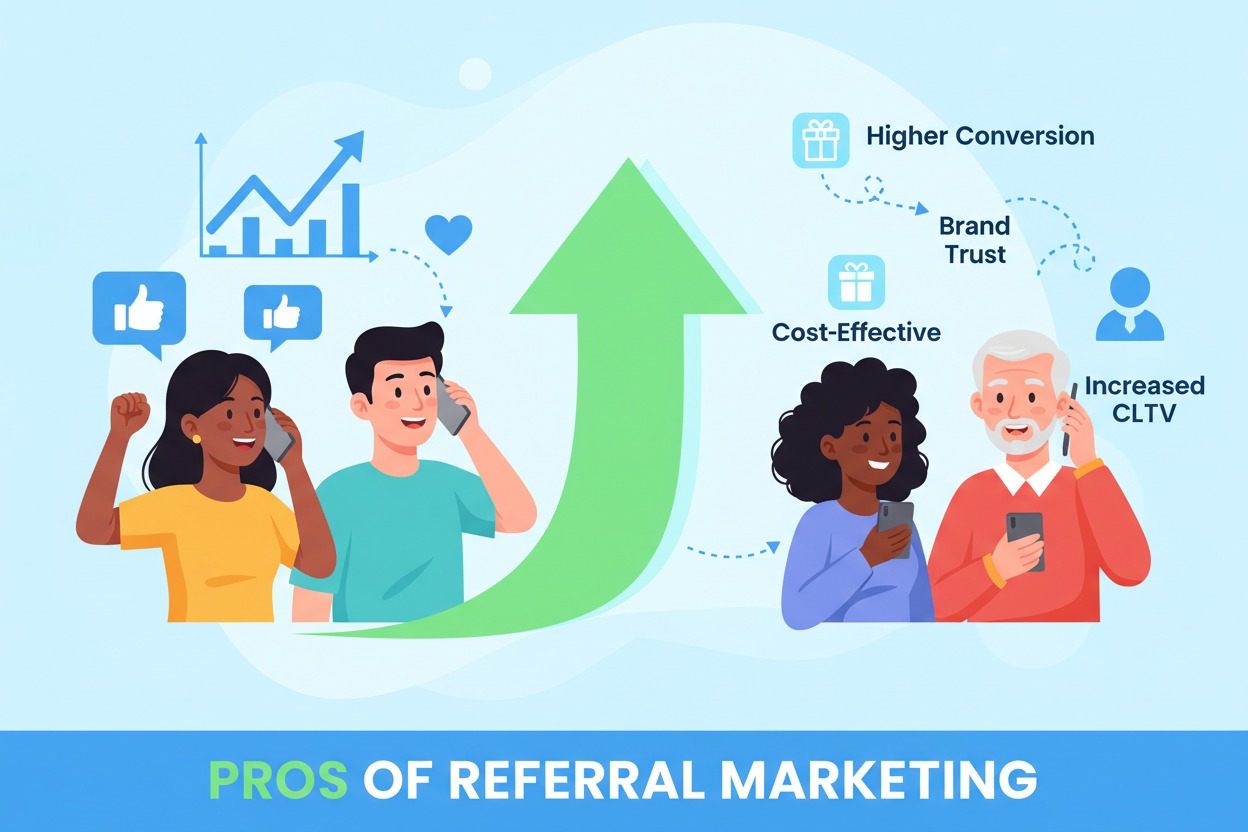
Every marketing channel carries trade-offs. Understanding both sides of a referral marketing strategy helps small business owners set realistic expectations and build programmes that account for potential limitations.
- Lower customer acquisition cost — Referral customers typically cost significantly less to acquire than those from paid advertising channels.
- Higher quality leads — Prospects arrive pre-qualified and predisposed to convert, having received a personal recommendation from someone they trust.
- Improved customer retention — Referred customers demonstrate stronger brand loyalty and lower churn rates over time.
- Scalable growth mechanism — Once the infrastructure is in place, the programme can grow without proportional increases in marketing spend.
- Strengthened customer relationships — Rewarding advocates deepens their emotional connection to the brand and encourages repeat purchases.
- Measurable and attributable results — Unlike organic word-of-mouth, structured referral programmes provide clear attribution data for reporting and optimisation.
Programme fatigue is a genuine risk if incentives are poorly designed or if customers are contacted too frequently. Reward structures that feel transactional rather than generous can actually damage brand perception rather than enhance it.
Fraud and abuse represent another consideration. Without proper verification mechanisms, some participants may attempt to game the system through fake referrals or self-referrals. Robust platforms include safeguards, but this requires ongoing monitoring.
The strategy also depends heavily on having a satisfied existing customer base. Businesses with high complaint rates or poor retention will find referral programmes difficult to activate, as unhappy customers are unlikely to advocate regardless of incentive.
Who Is This Referral Marketing Strategy For?
Referral marketing is not a one-size-fits-all solution, but it is remarkably versatile. The businesses that see the strongest results share certain characteristics — they have an existing customer base, a product or service worth recommending, and the operational capacity to fulfil rewards consistently.
E-commerce store owners are among the primary beneficiaries. With existing customer data, transactional email flows, and platform integrations already in place, launching a referral programme requires minimal additional infrastructure. Brands selling consumable or repeat-purchase products see particularly strong results.
Service-based businesses — including consultancies, agencies, fitness studios, and salons — thrive with referral programmes because trust is central to the buying decision. A personal recommendation carries enormous weight when the service is relationship-driven.
“The best referral programmes don’t feel like marketing — they feel like sharing something genuinely valuable with a friend.” — Jay Baer, Marketing Strategist
Growth-focused brands preparing to scale will find referral marketing especially valuable during the transition from founder-led sales to systematic acquisition. It bridges the gap between personal relationships and repeatable processes.
SaaS businesses and subscription-based models also benefit strongly, as the lifetime value of each acquired customer justifies meaningful referral incentives. The maths work particularly well when monthly recurring revenue compounds over time.
Pricing and Value: Is a Referral Marketing Strategy Worth the Investment?
For small businesses evaluating marketing spend, the cost-to-value ratio of a referral programme is exceptionally favourable compared to most alternatives. The investment required varies depending on whether you build a custom solution or use an established platform.
UpViral is a popular referral and viral marketing software designed to help businesses grow their audience through engaging referral campaigns. It offers various pricing plans starting from £79 per month for the Basic plan, which includes essential features like unlimited campaigns and up to 5,000 leads. The Pro plan, priced at £99 per month, adds advanced capabilities such as integrations with email marketing tools and priority support. For larger businesses, the Enterprise plan provides custom solutions and higher lead limits.
Users generally praise UpViral for its intuitive interface, powerful automation features, and strong lead generation capabilities. However, some users mention that the platform can be challenging for beginners to master, and the pricing may be higher compared to more basic referral tools. Read Full Upviral review
Dedicated referral software typically ranges from £30 to £400 per month, depending on the platform and feature tier. ReferralCandy starts at approximately £39 per month for e-commerce brands, whilst Mention Me and Friendbuy are positioned at higher price points, targeting mid-market and enterprise clients. Many platforms offer free trials lasting 14 to 30 days, allowing businesses to test programme mechanics before committing.
Beyond software costs, the primary ongoing expense is the reward budget — the incentives paid out to referrers and referees. Because rewards are only triggered by successful conversions, this cost scales directly with revenue generated. A well-structured programme typically allocates 5–15% of the referred order value as an incentive, keeping margins intact.
When compared against pay-per-click advertising, where costs per acquisition frequently exceed £50–£150 in competitive sectors, referral marketing’s typical acquisition cost of £10–£30 represents a substantial saving. Over a 12-month period, even a modest programme generating 50 referred customers per month can deliver tens of thousands of pounds in incremental revenue at a fraction of conventional advertising spend.
The return on investment becomes even more compelling when lifetime value is factored in. Referred customers spend more, churn less, and are more likely to refer others — creating a compounding effect that grows in value over time. For most small businesses, the question is not whether referral marketing is worth the investment, but how quickly to implement it.
Alternatives to Consider
Whilst a referral marketing strategy delivers strong results, it is worth understanding the alternative acquisition channels available to small businesses and how they compare.
Affiliate marketing is the closest structural alternative. Rather than incentivising existing customers, affiliate programmes recruit external publishers, influencers, or content creators to promote your brand for a commission. The reach can be broader, but the trust factor is generally lower, and affiliate relationships require more active management. Platforms such as ShareASale and Impact facilitate this at scale.
Loyalty programmes focus on retaining existing customers rather than acquiring new ones. Tools like Smile.io or LoyaltyLion reward repeat purchases with points and perks, which can complement a referral strategy but do not replace the acquisition function.
Email marketing remains one of the highest-ROI channels for small businesses, with platforms including Klaviyo, Mailchimp, and ActiveCampaign offering sophisticated automation at accessible price points. However, email marketing works best with an existing list — it does not independently solve the new customer acquisition challenge.
Paid social advertising via Meta Ads or Google Ads offers speed and targeting precision but carries significant cost risk, particularly for businesses without dedicated media buying expertise. Cost per acquisition tends to be higher, and results disappear the moment spend stops.
Content marketing and SEO build long-term organic visibility but require sustained investment over months or years before generating meaningful returns — making them less suitable as a primary short-term acquisition channel.
The strongest approach for most small businesses is to combine referral marketing with one or two complementary channels, using referrals as the trust-driven foundation and supplementing with email or organic content to nurture and retain.
Final Verdict
A well-executed referral marketing strategy remains one of the most cost-effective and scalable acquisition channels available to small businesses. It leverages the trust already embedded in your customer relationships, converting genuine satisfaction into measurable growth.
The barriers to entry are lower than ever. Accessible platforms, straightforward integrations, and performance-based cost structures mean that businesses of almost any size can launch a credible programme without significant upfront risk.
For marketing teams and small business owners seeking sustainable growth without over-reliance on paid advertising, referral marketing deserves a central position in the acquisition strategy — not a peripheral one. The data supports it, the mechanics are proven, and the compounding returns make early adoption a clear competitive advantage.
Conclusion
A referral marketing strategy is not simply a growth tactic — it is a structural shift in how small businesses think about customer acquisition. By placing trust, relationships, and genuine satisfaction at the centre of your marketing approach, you create a self-reinforcing system that compounds in value over time.
The evidence is consistent: referred customers convert faster, spend more, and stay longer. The cost efficiencies are measurable, the tools are accessible, and the mechanics are proven across industries ranging from e-commerce to professional services.
For small businesses ready to move beyond expensive paid channels and build something more durable and authentic, referral marketing offers a clear path forward. Start with a simple incentive structure, choose a platform that integrates with your existing tools, and focus on delivering an experience worth recommending. The programme will do the rest — turning your most satisfied customers into your most valuable growth asset.
Frequently Asked Questions
How quickly can a small business see results from a referral marketing strategy?
Most small businesses begin seeing measurable activity within the first four to eight weeks of launching a structured programme. Initial results depend on the size of your existing customer base, the attractiveness of the incentive, and how actively the programme is promoted. Businesses with engaged email lists or active social communities tend to see faster uptake. Conversion rates from referred leads typically materialise within the first referral cycle.
What is the best incentive to offer in a referral programme?
The most effective incentive depends on your business model and customer behaviour. For e-commerce brands, two-sided discounts — rewarding both the referrer and the new customer — consistently outperform one-sided rewards. Subscription businesses often achieve strong results with free months or account credits. The key principle is mutual benefit: both parties should feel they are receiving genuine value, not a token gesture.
Do I need specialist software to run a referral programme?
Not necessarily, but dedicated platforms significantly improve programme performance and reduce administrative burden. Tools such as Upviral, ReferralCandy, Referral Rock, or Mention Me handle tracking, reward fulfilment, and analytics automatically. For very early-stage businesses, a manual approach using unique discount codes is a viable starting point — though it limits scalability and attribution accuracy.
How do I prevent fraud in my referral programme?
Reputable referral platforms include built-in fraud detection mechanisms such as duplicate email checks, IP address monitoring, and minimum purchase thresholds before rewards are released. Setting a qualifying purchase requirement — where the referee must complete a genuine transaction before the referrer receives their reward — eliminates most self-referral abuse. Regular auditing of referral activity also helps identify unusual patterns early. Upviral can automatically detect and prevent fraud using built-in features such as duplicate email checks, IP address monitoring, and purchase verification to ensure genuine referrals.
Can referral marketing work for service-based businesses without an online presence?
Yes. While digital tools enhance scalability, the core referral mechanic works equally well offline. Service businesses such as tradespeople, therapists, or local retailers can implement simple card-based or verbal referral schemes with manual reward fulfilment. The trust element that makes referrals so effective is, if anything, even stronger in face-to-face service relationships where personal recommendation carries significant weight.
Leave a Reply