
Table of Contents
“The best marketing doesn’t feel like marketing — it feels like an opportunity.” This is precisely the promise that viral giveaway tools make to businesses of every size.
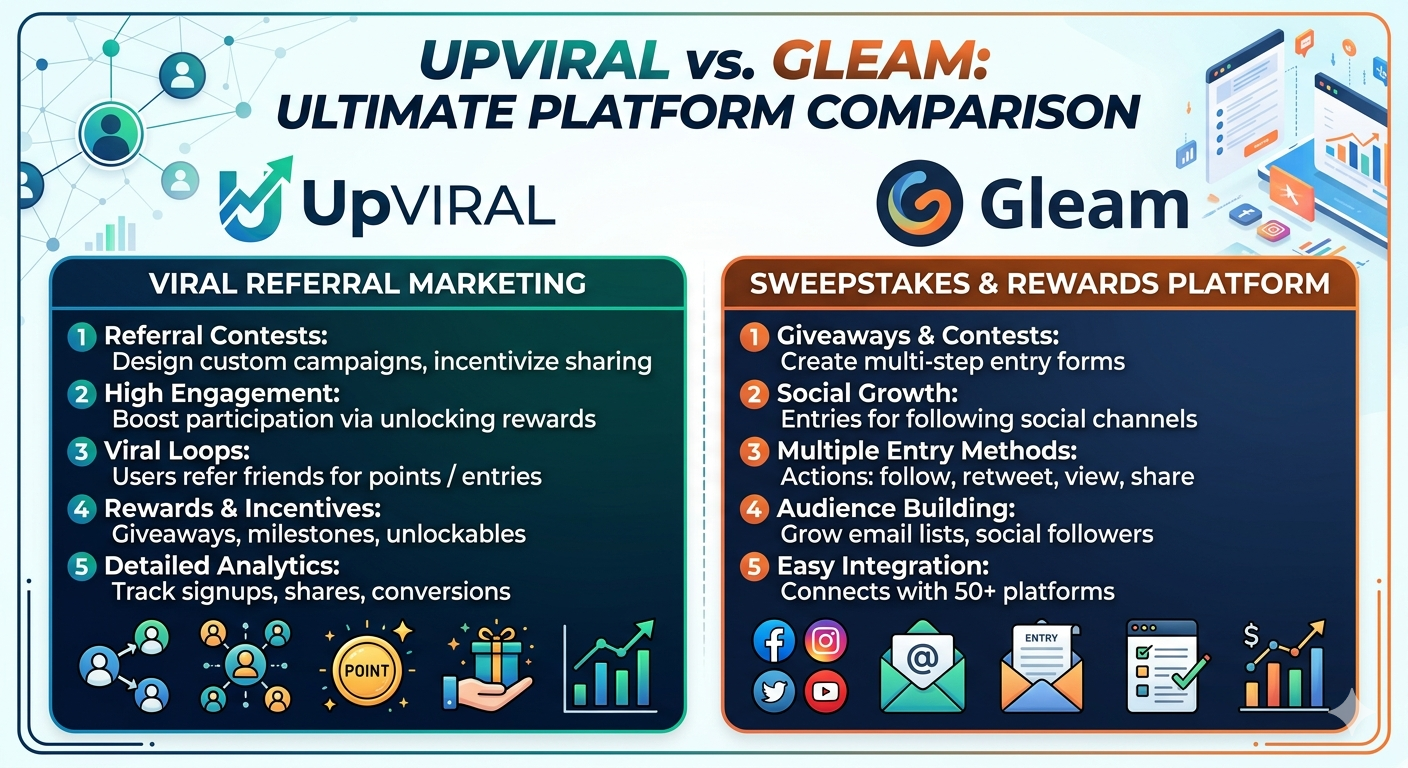
If you’ve been exploring ways to grow your email list, boost social media followers, or drive traffic to your Shopify or WooCommerce store, you’ve likely encountered two popular names in the giveaway software space: UpViral vs Gleam. Both platforms promise to help you run compelling contests and referral campaigns, but they approach the goal in meaningfully different ways.
The upviral vs gleam debate isn’t simply about features — it’s about which tool aligns with your specific growth strategy, audience, and budget. A content creator running a seasonal giveaway has very different needs from a growth-focused e-commerce brand building a long-term referral engine. Choosing the wrong platform can mean wasted spend, poor participant experience, and missed opportunities to convert entrants into loyal customers.
In this comparison, we’ll break down everything that matters: campaign formats, entry mechanics, integrations, pricing, ease of use, and real-world performance. Whether you’re a small business owner launching your first giveaway or an experienced marketer looking to scale your lead generation, this guide will help you make a confident, informed decision.
By the end, you’ll have a clear picture of which platform delivers better return on investment, which is easier to set up without a technical team, and which one gives you the viral mechanics to genuinely grow your audience — not just inflate your vanity metrics.
Let’s get into it.
Overview: Upviral vs Gleam at a Glance
| Feature | UpViral | Gleam |
|---|---|---|
| Primary Use Case | Referral-driven viral campaigns | Multi-action contest and giveaway management |
| Best For | Email list growth, referral loops | Social media engagement, brand awareness |
| Pricing Start | From $79/month | From $10/month (free plan available) |
| Free Plan | No (trial available) | Yes (limited) |
| Ease of Setup | Moderate | Beginner-friendly |
| Viral Mechanics | Strong (referral-first design) | Moderate (action-based entries) |
| Integrations | Mailchimp, ActiveCampaign, HubSpot | Shopify, Mailchimp, Discord, YouTube |
Giveaway software has evolved considerably over the past decade, moving from simple random-draw tools to sophisticated growth platforms capable of driving measurable business outcomes. Both UpViral and Gleam sit at the more capable end of this spectrum, but they serve slightly different masters.
What Is UpViral?
UpViral is a dedicated referral marketing platform built specifically around the concept of viral sharing. Launched by Wilco de Kreij, it’s designed to turn each contest participant into a promoter by rewarding them for referring friends. The platform’s core philosophy is that word-of-mouth amplification is the most cost-effective growth channel available to modern businesses.
UpViral campaigns are structured around a points-and-rewards system where entrants earn additional entries by sharing unique referral links. This makes it particularly powerful for email list building, product launches, and lead generation funnels. It integrates directly with major email service providers and CRM tools, making it a natural fit for businesses that treat their list as a core asset.
You can start a 14-day trial today and explore all the features risk-free. Enjoy full access and cancel anytime within the trial period without any charges.
What Is Gleam?
Gleam is a versatile competition and rewards platform that offers a broader range of campaign types, including giveaways, instant win competitions, galleries, and loyalty rewards. Founded in Melbourne, Australia, Gleam has built a reputation for being accessible and flexible — particularly appealing to content creators, influencers, and brands running frequent social media promotions.
Where UpViral focuses on referral loops, Gleam focuses on multi-action entry mechanics, allowing participants to earn entries by following accounts, watching videos, visiting websites, or engaging with content across multiple platforms simultaneously.
Key Features Compared

When comparing UpViral vs Gleam, the differences become most apparent when you examine the specific mechanics that power each campaign. Feature depth and design philosophy vary significantly between the two platforms.
Campaign Types and Giveaway Formats
- UpViral supports referral giveaways, sweepstakes, and waitlist campaigns with viral sharing built into every format.
- Gleam supports competitions, instant win campaigns, gallery contests (user-generated content), and rewards programmes.
- UpViral’s campaign builder is optimised for a single, focused outcome — growing your list through referrals.
- Gleam allows you to embed campaigns directly onto your website, blog, or Shopify product page with minimal friction.
- UpViral offers milestone rewards, where participants unlock prizes at specific referral thresholds.
- Gleam’s template library includes pre-built campaign structures for product launches, seasonal promotions, and influencer collaborations.
Entry Methods and Viral Mechanics
“Referral mechanics are the difference between a giveaway that ends and one that compounds.” — Growth marketing practitioners consistently point to referral loops as the highest-leverage entry mechanic available.
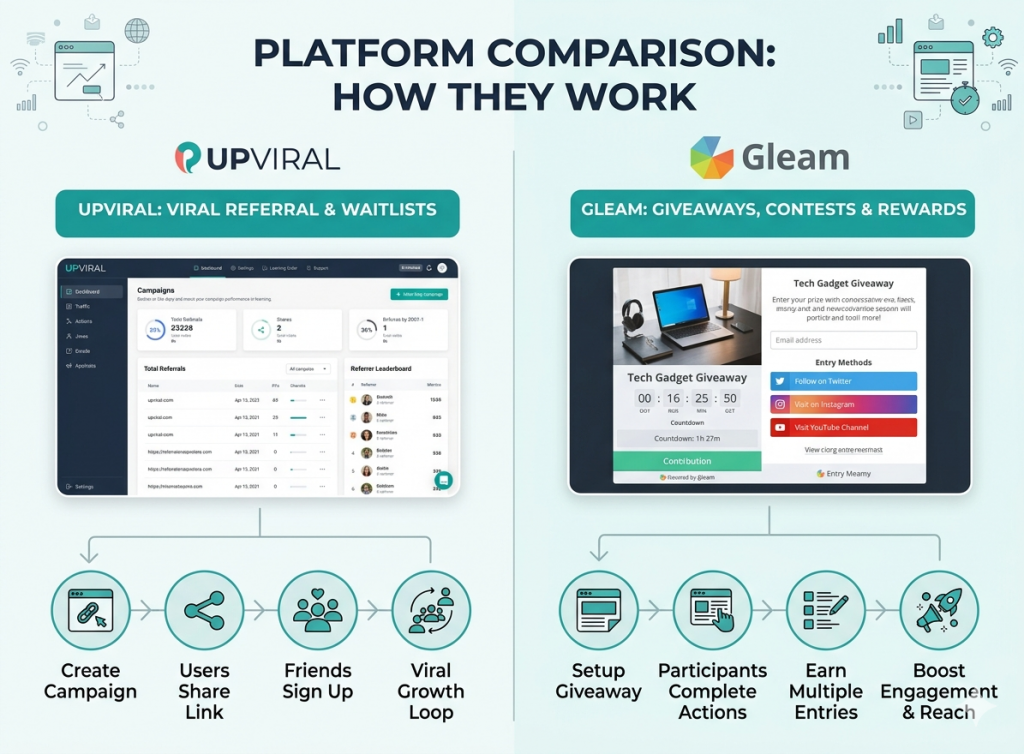
UpViral’s referral-first architecture means every campaign is engineered to spread organically. Participants receive a unique sharing link, and every successful referral earns additional entries — creating a self-reinforcing loop.
Gleam takes a broader approach, allowing entrants to complete social actions such as following an Instagram account, subscribing to a YouTube channel, or joining a Discord server. This generates engagement across multiple channels simultaneously, though the viral coefficient is typically lower than a dedicated referral system.
Integrations and Platform Compatibility
Integration capability is a deciding factor for many businesses. UpViral connects natively with Mailchimp, ActiveCampaign, ConvertKit, HubSpot, and Zapier, making it well-suited to email-first marketing stacks. Gleam extends further into social and e-commerce territory, with direct Shopify integration, Discord support, Twitch connectivity, and YouTube verification — making it the stronger choice for content-driven brands and community-led businesses.
Performance in Practice
“A tool is only as good as the results it delivers under real-world conditions — not just in a demo environment.”
When evaluating the upviral vs gleam question beyond feature lists, actual campaign performance is where meaningful differences emerge. Conversion rate, referral velocity, and list quality are the metrics that matter most to growth-focused brands and e-commerce operators.
Engagement depth also varies considerably between the two platforms depending on your audience type and campaign goal.
Running a Giveaway: UpViral Experience
Running a campaign through UpViral feels deliberately focused on outcomes. Once your campaign is live, the referral engine kicks in immediately — participants receive their unique sharing link and are incentivised to spread it across email, WhatsApp, Facebook, and other channels. Businesses using UpViral for product launches commonly report referral rates where a single engaged participant generates three to five additional sign-ups.
The lead quality from UpViral campaigns tends to be higher than average because referred participants arrive with a degree of social endorsement. They weren’t served a cold ad — they were invited by someone they trust. For Shopify and WooCommerce store owners building a pre-launch list or promoting a seasonal sale, this distinction translates directly into better post-campaign email open rates and purchase conversion.
The trade-off is that UpViral campaigns require more strategic setup. You need a compelling reward structure and a clear referral incentive to activate the viral loop effectively. You can start a 14-day trial today and explore all the features risk-free. Enjoy full access and cancel anytime within the trial period without any charges.
Running a Giveaway: Gleam Experience
Gleam campaigns tend to generate volume quickly, particularly when social actions are involved. A well-structured Gleam competition asking entrants to follow an Instagram account, share a post, and visit a product page can accumulate thousands of entries within days — especially when promoted by influencers or through paid social.
However, the breadth of entry actions can sometimes dilute participant intent. Entrants completing ten different social tasks may not be deeply invested in your brand. For content creators and community-driven brands, this broad engagement model works well. For businesses prioritising qualified leads over raw numbers, the results require more careful post-campaign filtering.
Ease of Use and Setup
Getting a campaign live quickly matters — particularly for small business owners without dedicated marketing teams. When comparing UpViral vs Gleam, both platforms have invested in their onboarding experience, but the learning curve differs noticeably.
- Create your account — UpViral requires selecting a paid plan before launching, while Gleam allows you to begin building on its free tier immediately.
- Choose your campaign type — Gleam’s template library makes this step faster, with clearly labelled formats for competitions, instant wins, and galleries. UpViral’s options are fewer but more focused.
- Configure entry mechanics — UpViral’s referral setup requires you to define reward tiers and sharing incentives, which takes additional time. Gleam’s action-based entries can be added or removed in seconds.
- Customise your design — Both platforms offer drag-and-drop editors, though Gleam’s widget styling options are more flexible for embedding campaigns within existing website designs.
- Connect your integrations — UpViral’s email service provider connections are straightforward for users already on Mailchimp or ActiveCampaign. Gleam’s Shopify integration is notably smooth for e-commerce operators.
- Preview and publish — Gleam allows instant embedding via a JavaScript snippet or direct link. UpViral provides a hosted campaign page that can be shared or embedded.
Gleam wins on initial setup speed — most users can have a basic competition live within 20 to 30 minutes. UpViral rewards the time invested in configuration with stronger viral mechanics, but first-time users should allocate at least an hour to build a campaign that performs well.
Technical knowledge required is minimal for both platforms, though UpViral’s reward structure and webhook configuration options assume a slightly higher level of marketing sophistication.
Pricing and Value for Money
| Plan | UpViral | Gleam |
|---|---|---|
| Free Tier | Not available (14-day trial) | Yes — limited to 1 active campaign |
| Entry Level | $79/month (Starter) | $10/month (Hobby) |
| Mid Tier | $149/month (Business) | $29/month (Pro) |
| Top Tier | $199/month (Premium) | $79/month (Business) |
| Annual Discount | Up to 40% off | Up to 30% off |
| Campaign Limits | Unlimited on all paid plans | Varies by plan |
Pricing structures reveal the fundamentally different markets each platform targets.
UpViral Pricing Breakdown
UpViral’s pricing reflects its positioning as a premium lead generation tool. The entry-level Starter plan at $79/month includes unlimited campaigns, unlimited leads, and core integrations — making it reasonable for businesses actively running multiple campaigns. The return on investment calculation is straightforward: if a single referral campaign generates 500 qualified email subscribers who convert at even a modest rate, the monthly cost is easily justified.
Annual billing brings the effective monthly cost down significantly, which rewards committed users. You can start a 14-day trial today and explore all the features risk-free. Enjoy full access and cancel anytime within the trial period without any charges.
Gleam Pricing Breakdown
Gleam’s tiered pricing model is considerably more accessible, with a functional free plan that allows small creators and early-stage businesses to test the platform before committing. The Hobby plan at $10/month unlocks additional campaign types and removes Gleam branding — a meaningful upgrade for brand-conscious operators.
For Shopify store owners and influencers running frequent promotions, the Pro plan at $29/month offers strong value. Gleam’s Business plan at $79/month — the same price as UpViral’s entry tier — includes advanced features like priority support and higher campaign limits, making the cost comparison between the two platforms particularly interesting at this price point.
Pros and Cons
No platform is perfect, and understanding the genuine trade-offs of each tool is essential before committing your budget. When comparing UpViral vs Gleam, UpViral’s greatest strength is also its primary limitation — its laser focus on referral mechanics means it excels at one thing but offers less flexibility for brands that need variety in their campaign formats.
Key strengths of UpViral:
- Referral loop architecture that compounds participant reach organically
- High lead quality due to the social trust embedded in referral sharing
- Unlimited campaigns on all paid plans, offering strong scalability
- Deep email marketing integrations with major platforms like ActiveCampaign and HubSpot
- Milestone reward structures that sustain participant motivation throughout a campaign
- Develop and design engaging, high-converting landing pages tailored to your specific audience and business goals
- Expand your presence and grow your audience on social media platforms by engaging consistently and sharing valuable content that resonates with your followers and attracts new ones.
Key limitations of UpViral:
- No free plan, making it a harder commitment for early-stage businesses
- Steeper learning curve compared to Gleam, particularly around reward configuration
- Less suited to social media engagement goals or community-building campaigns
- Fewer campaign format options for brands that run varied promotions
Key strengths of Gleam:
- Accessible free tier and affordable entry-level pricing
- Broad multi-action entry mechanics that drive engagement across multiple platforms simultaneously
- Strong Shopify and social media integrations ideal for e-commerce and content creators
- Fast setup with a well-stocked template library
Key limitations of Gleam:
- Lower referral velocity compared to UpViral’s dedicated referral engine
- Entry volume can inflate without corresponding improvement in lead quality
- Advanced features require higher-tier plans that approach UpViral’s pricing
“The right tool isn’t always the most powerful one — it’s the one that solves your specific problem most efficiently.”
Ultimately, neither platform is objectively superior. The decision hinges on your primary campaign objective: deep referral-driven list growth, or broad multi-channel engagement.
Who Is This For?
Understanding which platform fits your situation requires honest reflection on your goals, technical comfort, and the type of audience you’re trying to build. When comparing UpViral vs Gleam, both tools serve legitimate use cases, but they are not interchangeable.
UpViral is the stronger choice for the following scenarios:
- E-commerce store owners running pre-launch campaigns or product waitlists who need to build a qualified email list quickly through referral incentives.
- Growth-focused brands with an existing email marketing stack (Mailchimp, ActiveCampaign, HubSpot) who want to integrate giveaway campaigns directly into their lead nurturing workflows.
- Digital product creators launching courses, memberships, or software products who need a viral referral engine to amplify reach before launch day.
- Small business owners willing to invest setup time in exchange for higher-quality leads and a self-sustaining referral loop.
- Marketing teams running recurring campaigns across multiple product lines who benefit from unlimited campaign access on a single plan.
Gleam is the stronger choice for these scenarios:
- Content creators and influencers who regularly run social media giveaways and need a fast, flexible tool that supports multi-platform entry actions without complex configuration.
- Shopify store owners seeking seamless e-commerce integration for seasonal promotions, flash sales, or community-building competitions.
The pricing entry point also shapes the decision significantly. Businesses operating on tighter budgets — particularly solo creators or early-stage startups — will find Gleam’s free and low-cost tiers far more accessible as a starting point.
Audience composition matters too. If your target audience is highly active on Instagram, TikTok, or YouTube, Gleam’s social action mechanics align naturally with where your audience already spends their time. If your audience responds to email-first communication and values exclusive access or referral rewards, UpViral’s architecture suits them better.
Alternatives to Consider
While the upviral vs gleam comparison covers two of the most recognised platforms in the giveaway software space, they are not the only options worth evaluating. Depending on your specific needs, one of the following alternatives may offer a better fit.
| Platform | Best For | Free Plan | Starting Price | Key Differentiator |
|---|---|---|---|---|
| Viral Loops | Referral programmes and ambassador campaigns | Yes (limited) | $49/month | Pre-built referral templates modelled on Dropbox and Airbnb growth loops |
| RafflePress | WordPress users running embedded giveaways | Yes (limited) | $39.20/year | Native WordPress plugin with drag-and-drop builder |
| KingSumo | Email list growth via simple viral giveaways | Yes | $198 lifetime | One-time payment model with strong simplicity |
| Woobox | Agencies and brands needing multi-format promotions | Yes (limited) | $32/month | Supports polls, coupons, photo contests, and sweepstakes |
| Vyper | Influencer-driven campaigns and brand ambassador programmes | No | $149/month | Leaderboard mechanics and reward tiers for high-engagement audiences |
| Shortstack | Custom-branded campaigns with advanced design control | Yes (limited) | $99/month | Highly customisable landing pages and white-label options |
Each of these platforms occupies a distinct niche. RafflePress is particularly compelling for WordPress-native businesses that want embedded campaigns without leaving their existing CMS. KingSumo appeals to budget-conscious operators who prefer a one-time investment over recurring subscription costs. Viral Loops is worth serious consideration for any business whose primary goal mirrors the referral-loop growth models popularised by Dropbox and Airbnb.
Before defaulting to UpViral or Gleam, it’s worth mapping your campaign goals against this broader landscape to ensure you’re selecting the tool best aligned with your growth strategy.
Final Verdict
After a thorough comparison across features, pricing, ease of use, and real-world performance, the upviral vs gleam decision comes down to one fundamental question: what does success look like for your campaign?
If your primary goal is building a high-quality email list through referral-driven growth, UpViral is the stronger platform. Its referral-first architecture, milestone reward structures, and deep integration with major email marketing tools make it purpose-built for businesses that treat list growth as a core revenue driver. The higher price point is justified when campaigns are structured correctly — the compounding effect of referral loops can deliver a cost per lead that outperforms most paid acquisition channels.
You can start a 14-day trial today and explore all the features risk-free. Enjoy full access and cancel anytime within the trial period without any charges.
If your priority is broad social media engagement, rapid setup, or running varied campaign formats on a limited budget, Gleam is the more practical choice. Its accessible pricing, flexible entry mechanics, and strong Shopify and social integrations make it an excellent tool for content creators, influencers, and e-commerce brands running frequent promotions.
Neither platform is the universal winner. UpViral rewards strategic investment with superior referral velocity and lead quality. Gleam rewards speed and flexibility with lower barriers to entry and wider platform reach.
For growth-focused brands with a clear email-first strategy and budget to match, UpViral earns the edge. For everyone else — particularly those just getting started — Gleam offers exceptional value and versatility that is difficult to overlook.
Conclusion
Choosing between UpViral vs Gleam isn’t a matter of picking the objectively better product — it’s a matter of matching the right tool to your specific growth objectives. Both platforms are genuinely capable, well-supported, and used successfully by thousands of businesses worldwide.
UpViral stands out as the premier referral marketing engine for businesses serious about list building. Its viral mechanics are purpose-designed to compound reach, and when paired with a strong email nurture sequence, it can become one of the most cost-effective acquisition channels in your marketing stack. The investment in setup time and subscription cost pays dividends for brands committed to referral-led growth.
Gleam, by contrast, offers something equally valuable: accessibility and range. For Shopify store owners, content creators, and small businesses exploring giveaway marketing for the first time, Gleam provides a low-risk entry point with genuine capability at every pricing tier.
The smartest approach is to start with your campaign goal and work backwards. Define whether you need referral velocity or multi-channel engagement, identify your budget, and assess your technical comfort level. From there, the right platform becomes clear.
Whichever tool you choose, the most important factor remains consistent: a well-structured campaign with a compelling reward will always outperform a technically sophisticated one with a weak offer. The platform enables the strategy — but the strategy must come first.
Frequently Asked Questions
Is UpViral better than Gleam for growing an email list?
For dedicated email list growth, UpViral is generally the stronger choice. Its referral-first design means every campaign participant is incentivised to share their unique referral link, creating a compounding loop that consistently drives new sign-ups. Because referred participants arrive through a trusted personal recommendation rather than a cold advertisement, the resulting list tends to show higher open rates and stronger purchase intent. Gleam can also grow an email list, but its multi-action entry model prioritises broader social engagement over concentrated referral activity. If email list building is your primary objective, UpViral’s architecture is better aligned with that goal.
Can I use Gleam for free without paying anything?
Yes. Gleam offers a functional free plan that allows you to run one active campaign at a time with access to core entry actions. The free tier does include Gleam branding on your campaign widget, which may not suit brand-conscious operators. Upgrading to the Hobby plan at $10/month removes this branding and unlocks additional campaign types. For early-stage businesses, solo creators, or anyone wanting to test giveaway marketing before committing budget, Gleam’s free plan is a genuinely useful starting point. UpViral does not offer a free plan, though it does provide a 14-day trial to evaluate the platform before purchasing.
Which platform integrates better with Shopify?
Gleam has the stronger Shopify integration out of the box. Its native connection with Shopify allows store owners to embed campaigns directly on product pages, trigger competitions based on purchase behaviour, and sync participant data with their store. This makes it particularly well-suited to seasonal promotions, product launch giveaways, and customer loyalty campaigns. UpViral can be used alongside Shopify stores — particularly for pre-launch list building — but the integration is less direct and typically requires Zapier or manual configuration to connect campaign data with your store’s ecosystem.
How does UpViral’s referral system actually work?
When a participant enters an UpViral campaign, they receive a unique referral link tied to their entry. Every time that link results in a new sign-up, the original participant earns additional entries or reward points. Campaign owners can configure milestone rewards — for example, unlocking a bonus prize when a participant refers five friends — which creates sustained motivation to keep sharing. This architecture mirrors the growth models used by companies like Dropbox and Harry’s in their early stages. The result is a self-reinforcing loop where your most engaged participants become active promoters, extending your campaign’s reach without additional advertising spend.
Which tool is better for influencers and content creators?
Gleam is generally the better fit for influencers and content creators. Its multi-action entry mechanics align naturally with the platforms where creators operate — participants can earn entries by following an Instagram account, subscribing to a YouTube channel, joining a Discord server, or watching a specific video. This makes it easy to run cross-platform giveaways that simultaneously grow multiple audience channels. The fast setup, affordable pricing, and embeddable widget format also suit creators who run frequent promotions without a dedicated marketing team. UpViral can work for creators focused on building an email list, but its referral-centric design is less suited to the social-first engagement model that most content creators prioritise.
Leave a Reply